The Definitive Ranking of the World's Most Famous Car Brands
⚠️ Truyện hư cấu phục vụ giải trí. Nhân vật & tình tiết là sản phẩm tưởng tượng.
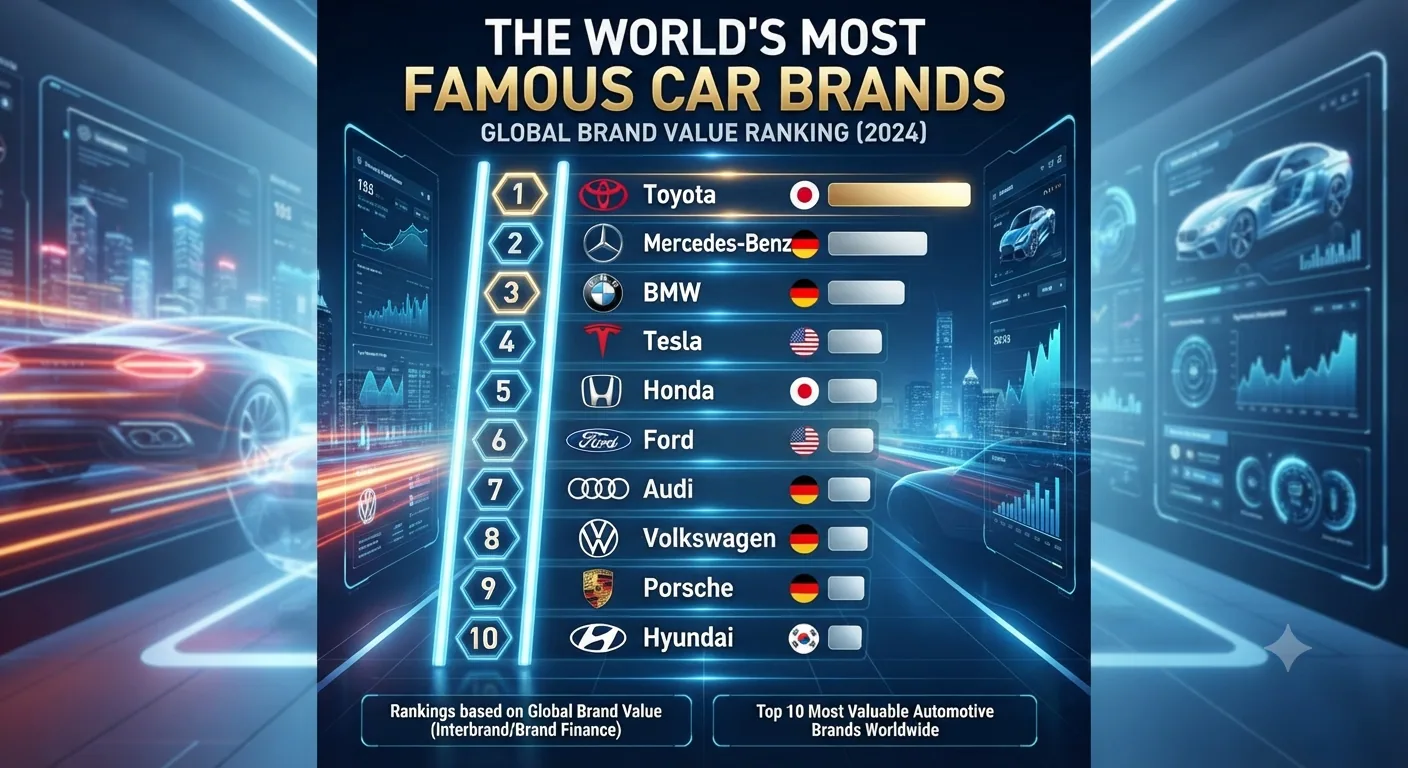
When we talk about the most famous car brands in the world, we are looking at a fascinating landscape where industrial manufacturing, global culture, technological disruption, and raw aspiration collide. The automotive world has never been static, but the hierarchy of fame and value has undergone some of the most dramatic shifts in its history over recent years. From century-old titans that produce tens of millions of vehicles across every continent to tech-driven insurgents that rewrite how cars are powered, sold, and updated, fame is measured in many ways. Some brands are famous for absolute scale and unyielding reliability, others for supreme luxury and heritage, and a select few for pioneering an entirely electric future that changed how humanity thinks about personal transportation. To understand this global ranking, we have to look past simple sales charts and examine how these corporate entities captured the human imagination, built trillion-dollar footprints, and became cultural touchstones.
At the very top of the global volume leaderboard sits Toyota, a Japanese industrial juggernaut that has defined modern manufacturing efficiency and long-term durability. For years, Toyota has anchored the number one spot in worldwide vehicle sales, turning out upwards of eleven million units annually through a tightly woven global network of factories. The fame of Toyota is not built on flashy hypercars or exotic design statements, but rather on an almost sacred reputation for reliability. When people buy a Toyota Corolla, a RAV4, or a Camry, they are buying a machine engineered to work day in and day out with minimal fuss, holding its resale value better than almost anything else on the market. Furthermore, Toyota played a high-stakes, long-term strategic game by perfecting gasoline-electric hybrid technology a full generation before many of its competitors took alternative powertrains seriously. While some critics argued that Toyota was too slow to embrace fully battery-electric vehicles, its massive network of practical hybrids allowed it to weather market shifts with immense financial stability and massive customer loyalty across every continent.
Hot on the heels of Toyota in the traditional volume race is the Volkswagen Group, the colossal German conglomerate that houses a diverse family of brands ranging from everyday hatchbacks to ultra-exclusive supercars. Volkswagen represents the peak of European industrial might, balancing the massive mainstream output of the Volkswagen brand itself with the engineering prestige of Audi, the rugged capability of Skoda, the emotional performance of Porsche, and the high-end luxury of Bentley and Lamborghini. Like Toyota, Volkswagen commands hundreds of billions of dollars in annual revenue, driven by millions of global sales. However, the German giant has faced a turbulent journey balancing its massive legacy production lines for internal combustion engines with an expensive, highly complex transition into software-defined electric vehicles. Despite internal corporate struggles and software delays, the sheer ubiquity of models like the Golf, the Tiguan, and the broader Audi and Porsche portfolios ensures that the Volkswagen Group remains an unavoidable heavyweight in any global ranking of automotive importance.
Moving away from sheer volume, we encounter a brand that dominates financial headlines and cultural discourse like no other: Tesla. While Tesla does not sell nearly as many cars as Toyota or Volkswagen, its market capitalization and cultural footprint have redefined the modern automotive paradigm. Tesla pioneered the transition from niche, high-priced electric novelties to mass-market battery-electric vehicles supported by a proprietary supercharging infrastructure and advanced software architectures. By treating vehicles more like rolling computers capable of over-the-air updates rather than static mechanical appliances, Tesla forced every legacy automaker on earth to completely revamp their research and development strategies. The Model Y and Model 3 became global phenomena, turning a Silicon Valley startup into a household name synonymous with the electric vehicle revolution. Even as traditional competitors close the gap and market dynamics shift, Tesla remains a defining symbol of modern automotive ambition and technological disruption.
Another massive seismic shift in the global rankings is the meteoric rise of Chinese manufacturers, led most prominently by BYD. Moving at a staggering pace, BYD transitioned from a battery manufacturer into a global powerhouse in electric and plug-in hybrid vehicles, capturing massive market share both domestically and through aggressive international expansion. Alongside other Chinese giants like Geely, SAIC, and Changan, BYD has challenged the traditional dominance of Western, Japanese, and Korean automakers. The sheer scale of China's domestic automotive market, combined with advanced supply chains for batteries and software integration, has propelled these brands into the upper echelons of global value and production volume. They are no longer regional players copying western designs; they are setting global benchmarks for pricing, electrification speed, and feature-packed interiors that leave legacy brands scrambling to compete.
In the realm of traditional prestige, the German triumvirate of Mercedes-Benz, BMW, and Audi continues to command immense global fame as the definitive benchmarks of executive luxury and driving dynamics. Mercedes-Benz remains the perennial symbol of ultimate automotive status. From the commanding presence of the S-Class to the rugged capability of the G-Wagon, Mercedes has spent over a century anchoring its identity in comfort, technological innovation, and unmistakable social prestige. BMW, on the other hand, carved out its fame through the relentless pursuit of driving dynamics, capturing the hearts of enthusiasts with the iconic 3 Series and a philosophy centered on the ultimate driving experience. Audi rounded out this premium trio with sleek styling, pioneering all-wheel-drive quattro technology, and beautifully crafted minimalist interiors. Together, these three German brands represent the gold standard of premium engineering, though they now face the delicate task of translating their hard-earned heritage of mechanical refinement into a digital, electric era.
Further down the geographic and cultural map, South Korea’s Hyundai Motor Group—encompassing Hyundai, Kia, and Genesis—has engineered one of the most impressive brand transformations of the twenty-first century. Once viewed as budget alternatives to Japanese and American cars, Hyundai and Kia evolved into design leaders and technological innovators, offering striking styling, exceptional build quality, and some of the most competitive electric vehicle platforms on the global market. Their ability to move quickly, adapt to consumer demands, and invest heavily in both hydrogen and battery technology has made them a dominant force in North America, Europe, and Asia alike. Meanwhile, American automotive icons like Ford and General Motors maintain their enduring fame through the sheer gravity of domestic loyalty, anchored by high-volume profit engines like the Ford F-Series and Chevrolet Silverado trucks, which remain cultural and economic pillars of North American life.
At the very peak of the pyramid, sitting entirely outside standard volume metrics, are the ultra-luxury and exotic brands like Ferrari, Porsche, and Lamborghini. Ferrari is a fascinating economic anomaly; it produces a strictly limited number of cars each year to preserve absolute exclusivity, yet commands a market valuation that rivals companies producing millions of vehicles. The prancing horse logo is arguably the most universally recognized symbol of wealth, speed, and passion on the planet. Porsche balances this high-end exclusivity with broader commercial success, using the profits from its sports-inspired SUVs like the Cayenne and Macan to fund the continuous evolution of the legendary 911 and cutting-edge electric sports cars like the Taycan. These brands prove that fame is not always about how many people can afford your product, but rather about how deeply people desire it.
Ultimately, the ranking of the world's most famous car brands is a tapestry of contrasting strengths. Toyota and Volkswagen rule the earth through industrial scale, manufacturing mastery, and mass reliability. Tesla and BYD rewrite the rules through electrification, software integration, and blistering market growth. Mercedes-Benz, BMW, and Audi maintain the eternal allure of status and performance, while Ferrari proves the enduring power of pure desire. As the automotive industry continues its rapid transformation toward autonomous features, digital ecosystems, and sustainable mobility, these iconic brands will continue to battle not just for sales numbers, but for a permanent place in human culture.