The Solar Debt Machine: How Predatory Leases Trap Homeowners
⚠️ Truyện hư cấu phục vụ giải trí. Nhân vật & tình tiết là sản phẩm tưởng tượng.
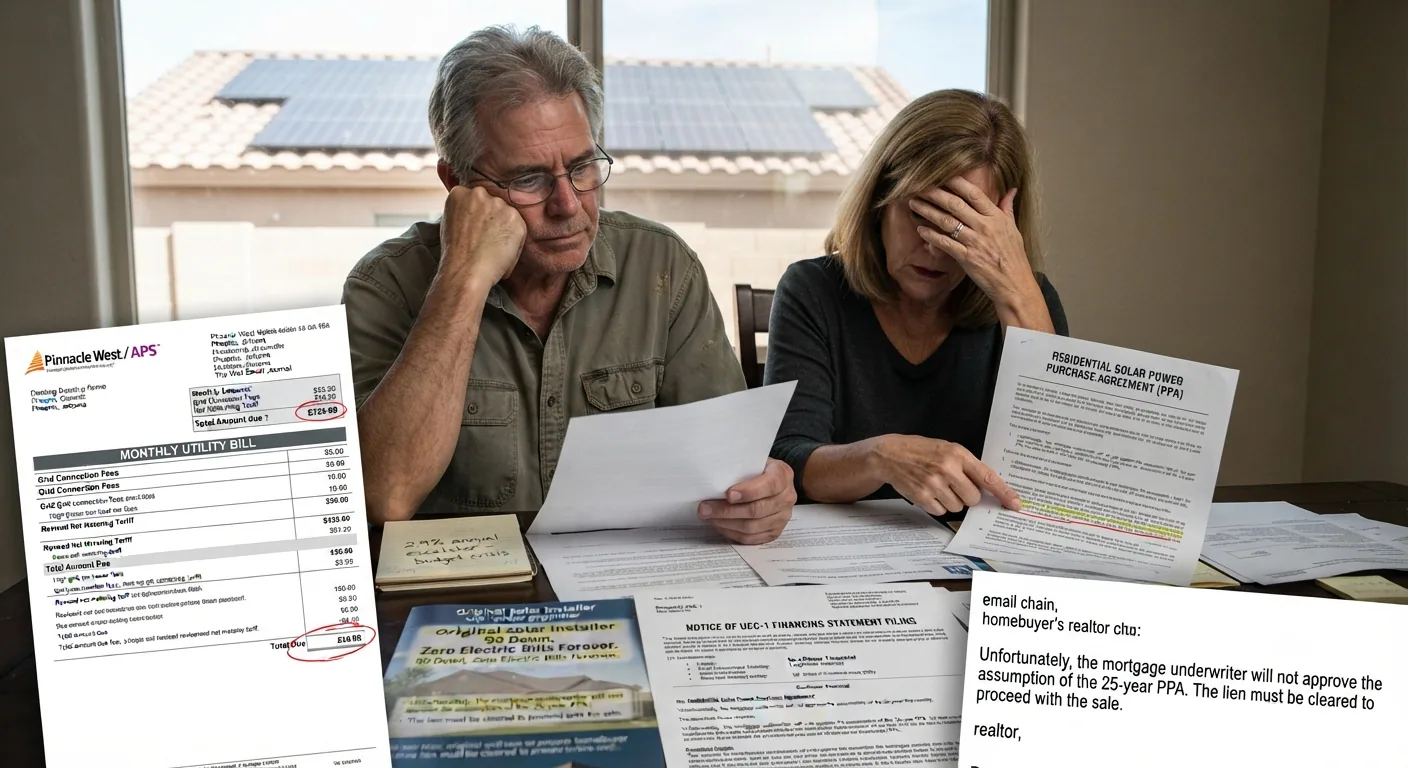
Ray and Linda Kowalski had lived in the same comfortable, single-story ranch home in Phoenix, Arizona, for nearly thirty years. By their late fifties, both had retired from long careers as school district workers, looking forward to peaceful years enjoying the desert warmth without the daily grind of alarm clocks and grading papers. Their retirement income was modest, carefully budgeted around their social security checks and a small state pension. Every dollar counted, and they took pride in keeping a close eye on their household expenses, particularly their summer electricity bills, which routinely skyrocketed when the desert sun pushed temperatures well past the one hundred and ten degree mark.
That was how the young man in the khaki pants and bright blue polo shirt found them on a quiet Tuesday afternoon in June. He knocked with confidence, flashing a warm, neighborly smile and carrying a sleek digital tablet. He introduced himself as an energy consultant representing a regional solar provider, though his badge carried a logo that was easy to mistake for a local utility affiliate. With practiced charm, he asked if Ray and Linda had noticed how much the local electric company had been raising rates over the past few years. It was a rhetorical question, of course. Everyone in Phoenix was feeling the squeeze of climbing utility costs.
The pitch was designed to be irresistible to homeowners on a fixed income. The salesman explained that solar energy was no longer just for the wealthy or the tech elite. Thanks to a special state initiative and federal green energy programs, the Kowalskis could install a brand-new rooftop solar array for zero dollars down. No upfront installation costs, no hidden equipment fees, and immediate protection from the unpredictable spikes of the electric grid. The salesman promised them that their days of paying punishing summer utility bills were officially over. He tapped rapidly on his tablet, pulling up a colorful chart that showed their current energy costs trending sharply upward, juxtaposed against a flat, predictable, and remarkably lower monthly payment for solar power.
For Ray and Linda, the proposition felt like a lifeline. It seemed almost unpatriotic to pass up clean energy that would simultaneously lower their monthly overhead. The salesman was attentive, polite, and reassuring, answering every tentative question with a ready smile and a barrage of technical jargon that sounded impressive and official. He assured them that the paperwork was standard procedure for municipal grid interconnection, pointing out various signature boxes with a sweeping gesture. Overwhelmed by the technical complexity and trusting the earnest young man sitting at their kitchen table, Ray and Linda signed their names on the digital screen. They believed they were simply signing up for cleaner, cheaper electricity that would make their retirement more secure.
They did not realize at the time that they had not purchased a solar system at all. Instead, they had entered into a twenty-five-year Power Purchase Agreement, commonly known as a PPA. Under the terms of this contract, they did not own the dark photovoltaic panels bolted to their roof, nor did they own the heavy inverters humming against the side of their garage. The solar company owned the equipment, leasing it back to the Kowalskis while claiming the lucrative thirty percent federal investment tax credit for themselves. Because Ray and Linda were retired and had relatively low tax liabilities, they could not fully utilize the tax credit anyway, which made the PPA seem like a clever workaround at first glance. But the contract also contained a ticking financial time bomb buried deep within its fine print: a two point nine percent annual escalator clause.
For the first twelve months, the arrangement felt like a triumph. Their utility bills dropped significantly, and their combined solar lease payment and leftover grid connection charges were indeed lower than what they used to pay during the scorching summer months. Ray and Linda felt a quiet sense of satisfaction every time they looked up at the gleaming panels soaking up the desert rays. They even told their neighbors about the wonderful deal they had secured, unknowingly encouraging others to listen to the door-to-door representatives who frequently combed their suburban neighborhood.
Trouble arrived slowly, then all at once, as regulatory shifts rippled through the energy landscape. States across the country, facing mounting pressure from traditional utility companies and grid maintenance costs, began overhauling their Net Energy Metering policies. In Arizona and neighboring states, regulators transitioned away from generous retail rate credits for daytime solar exports, slashing the compensation homeowners received when their panels pushed surplus electricity back onto the local grid. Under these new tariff structures, the value of exported solar energy plummeted by seventy to eighty percent. At the same time, the local utility introduced steep fixed grid connection fees specifically targeted at homes with rooftop solar systems, arguing that solar users still relied on the grid for backup power at night and needed to pay their fair share of infrastructure upkeep.
By the time Ray and Linda celebrated their third year with the solar array, the financial math of their contract had inverted completely. Their monthly solar lease payment, compounded by three consecutive years of the two point nine percent annual escalator, had grown noticeably higher. Add to that the new utility grid connection fees and the drastically reduced credits for their daytime power generation, and their total monthly energy expenses were suddenly higher than they had been before the panels were ever installed. The promise of zero electric bills forever had dissolved into a frustrating reality of paying two separate bills for the privilege of running their air conditioning.
When Ray called the solar leasing company to discuss their mounting financial distress, he was met with polite corporate indifference. The customer service representatives reminded him that he had signed a legally binding twenty-five-year contract. There was no easy exit clause, no grace period for economic hardship, and no provision for early cancellation without paying out the remainder of the contract value in a lump sum—a figure that amounted to tens of thousands of dollars. The burden of the escalating payments fell entirely on their fixed retirement income, forcing them to cut back on groceries, defer routine medical checkups, and abandon their small annual road trips to visit their grandchildren in Oregon.
The true magnitude of the trap, however, became painfully clear when life circumstances forced them to consider downsizing. As the maintenance of their large yard and sprawling ranch home grew increasingly burdensome, Ray and Linda decided it was time to sell the house and move into a modern, manageable single-level condominium closer to their daughter. They put their home on the market, priced competitively for the Phoenix suburbs, and quickly attracted a serious young couple eager to buy. The prospective buyers loved the house, the neighborhood, and the mature citrus trees in the backyard. The deal moved smoothly through the initial stages until it reached the mortgage underwriting desk.
Within days, the real estate transaction ground to a sudden and grinding halt. The buyers' mortgage lender refused to approve the loan unless the existing solar agreement was fully resolved. The underwriters viewed the twenty-five-year PPA not as a home improvement asset, but as an encumbrance—a long-term financial liability attached to the property that could threaten the new homeowner's ability to pay their primary mortgage. Furthermore, a title search revealed that the solar financing company had filed a UCC-1 financing statement against the property, registering a formal lien that secured the company's interest in the solar equipment. This lien meant that the house could not be sold, refinanced, or transferred until the solar contract was either assumed by the new buyer or completely bought out.
The prospective buyers balked at the prospect of inheriting a twenty-two-year solar lease with an escalating payment structure that they had never negotiated. They promptly walked away from the deal, leaving Ray and Linda stranded. Subsequent attempts to sell the home met the exact same roadblock. Every time an interested buyer appeared, the solar lien and the unfavorable lease transfer terms scared them off. Real estate agents in the area began warning Ray and Linda that their home had essentially become unsellable in its current condition, trapped in a legal and financial purgatory created by a signature they had given away on their living room rug three years prior.
The Kowalskis discovered that their experience was far from unique. Across the United States, hundreds of thousands of homeowners, particularly retirees and working-class families, have found themselves ensnared in similar rooftop solar financing traps. The residential solar industry, fueled by billions of dollars in private equity and venture capital, has experienced explosive growth. Yet this rapid expansion has often been driven by aggressive third-party sales organizations operating with minimal regulatory oversight. Commission-based door-to-door salesmen frequently utilize high-pressure tactics, preying on consumer desires for environmental stewardship and financial relief while deliberately obscuring the complex financial structures of leases, PPAs, and dealer fees.
Behind the polished marketing materials lies a labyrinth of hidden costs. Many consumers are unaware that cash purchases represent only a fraction of rooftop solar installations. The vast majority of residential projects are financed through specialized solar loans or third-party leases that carry exorbitant dealer origination fees—often hidden markups of twenty to thirty percent rolled directly into the total financed principal. A homeowner who believes they are financing a twenty-thousand-dollar solar system may actually be signing a financing agreement for twenty-six thousand dollars, with the difference consumed by broker commissions, lender fees, and administrative overhead.
Moreover, the complexity of these financial instruments creates a significant information asymmetry between sophisticated corporate lenders and everyday consumers. When homeowners sign a PPA or a solar lease, they surrender the federal tax incentives to corporations while retaining all the operational and financial risks of the equipment on their roofs. If the solar company goes bankrupt—a frequent occurrence in the volatile clean energy sector—homeowners can be left with orphaned systems that require specialized maintenance, with no warranty support and lingering liens clouding their property titles.
Regulatory agencies and consumer protection bureaus have struggled to keep pace with these innovative financial products. While federal and state governments pour billions of dollars into subsidies to accelerate the green energy transition, consumer advocacy groups warn that lax oversight has allowed predatory actors to exploit vulnerable populations. In states like California, Arizona, and Florida, complaints regarding deceptive sales practices, forged signatures, unauthorized credit pulls, and misleading savings estimates have surged into the tens of thousands. Yet recourse remains difficult, as binding arbitration clauses buried within the fine print of these contracts routinely strip consumers of their right to sue in public courts, forcing them into expensive and opaque private dispute resolution processes.
For Ray and Linda, escaping the solar trap required months of agonizing stress, dozens of tense phone calls with corporate legal departments, and a painful financial sacrifice. Ultimatel
Bài viết liên quan
Harvest of Glass: The Bitter Civil War Splitting Midwestern Farming Towns Over Solar Leases
Stranded Megawatts: Why America’s Biggest Solar Farms Are Built, Wired, and Forbidden to Turn On
The Eighty-Two Thousand Dollar Heart Attack: Surviving Medical Debt