Silicon on the Blockchain: How DePIN and Crypto Compute Markets Are Challenging Big Tech’s AI Monopoly
⚠️ Truyện hư cấu phục vụ giải trí. Nhân vật & tình tiết là sản phẩm tưởng tượng.
The modern artificial intelligence landscape is defined by an unprecedented contradiction. On one hand, open-source models like Meta's Llama series, Mistral, and specialized fine-tunes have commoditized intelligence, making state-of-the-art weights accessible to any developer with an internet connection. On the other hand, the physical supply chain required to run, fine-tune, and scale these models remains intensely centralized. A handful of hyper-scalers—cloud giants like Amazon Web Services, Microsoft Azure, and Google Cloud—control the vast majority of enterprise-grade AI accelerators, specifically Nvidia H100 and Blackwell clusters. This bottleneck creates an extraordinary market imbalance. Developers outside the walled gardens face exorbitant compute costs, supply shortages, and arbitrary API rate limits or content filtering policies. Furthermore, as artificial intelligence transitions from static chatbots to autonomous economic agents capable of executing code, transacting, and managing resources independently, traditional financial rails fail. Software programs cannot easily open corporate bank accounts, pass know-your-customer compliance checks, or make programmatic cent-level payments via traditional credit card networks.
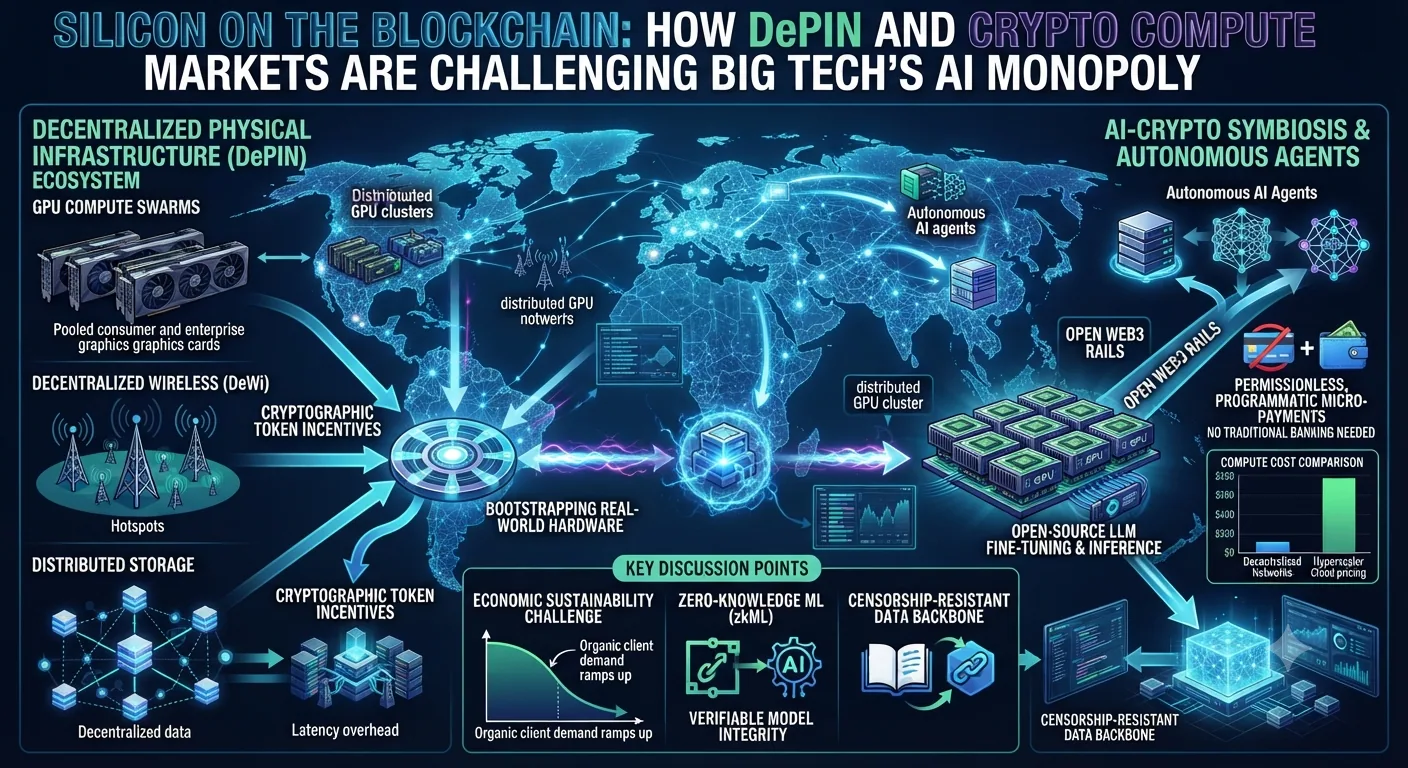
Enter the convergence of Web3 and Decentralized Physical Infrastructure Networks, commonly known as DePIN, combined with the emerging AI-crypto symbiosis. This fusion represents one of the most compelling structural shifts in modern technology. By deploying cryptographic token incentives, decentralized networks are successfully bootstrapping real-world hardware, distributed GPU clusters, wireless networks, and storage nodes at a scale that challenges traditional venture capital and corporate capex models. Instead of relying on centralized data centers built with billions in corporate debt, DePIN protocols leverage crowdsourced hardware participation, rewarding everyday contributors with native tokens for sharing idle GPU cycles, unused hard drive space, or excess bandwidth. This architecture fundamentally alters the economics of artificial intelligence, offering a censorship-resistant, permissionless alternative to the reigning cloud monopolies.
To understand how this revolution is unfolding, one must examine the mechanics of Decentralized Physical Infrastructure Networks. Traditional infrastructure deployment is capital intensive and geographically rigid. Building a traditional data center requires multi-year planning, permitting, massive real estate acquisitions, and direct negotiations with energy grids. When demand surges unexpectedly, as it did with the generative AI boom, scaling supply takes years. DePIN solves this coordination and capital expenditure problem through cryptoeconomics. By issuing a scarce, natively liquid digital asset, a protocol can subsidize the early stages of hardware deployment without central management. Early contributors take on hardware risk in exchange for protocol tokens, effectively bootstrapping a global compute network from the bottom up. Once the network reaches a critical mass of performance and reliability, organic demand from enterprises, researchers, and developers generates sustainable revenue, creating a closed-loop economic engine.
The most acute manifestation of this hardware race is the distributed GPU cluster. While hyper-scalers hoard advanced silicon in massive warehouses, millions of consumer and enterprise-grade graphics cards sit idle in homes, offices, and small server rooms around the world. Projects operating at the intersection of crypto and compute aggregate these fragmented resources into unified, programmable compute grids. Through specialized orchestration layers, developers can tap into distributed GPU swarms to run open-source large language model fine-tuning and inference at a fraction of hyperscaler cloud pricing. The economic arbitrage is substantial. Because these networks tap into existing capital assets—gaming PCs, mining rigs repurposed for AI, and underutilized enterprise servers—their marginal cost of operation is often lower than purpose-built cloud facilities that must amortize billions in infrastructure costs.
However, aggregating consumer-grade hardware introduces significant technical hurdles, primarily latency overhead and network reliability. Unlike a Tier 4 data center with redundant fiber-optic lines and enterprise-grade power supplies, decentralized nodes operate on residential broadband connections and diverse hardware specifications. Overcoming this requires sophisticated orchestration software capable of job scheduling, fault tolerance, and workload migration. If a node drops offline mid-training run due to a power outage or network disconnect, the orchestration layer must gracefully reassign the task without corrupting the model weights. Developers are building increasingly robust middleware that abstracts these hardware instabilities, turning a chaotic swarm of disparate machines into a cohesive, high-performance supercomputer.
Beyond compute raw power, the AI revolution requires massive volumes of data for training and validation. Decentralized storage and bandwidth networks serve as the censorship-resistant backbone for open-source AI datasets. Traditional cloud storage providers are susceptible to legal pressure, corporate data deletion policies, and sudden price hikes. Decentralized storage networks distribute data cryptographically across thousands of independent nodes worldwide, ensuring permanence, integrity, and resistance to single points of failure. This infrastructure is particularly vital for open-source AI development, where maintaining neutral, unalterable access to training corpora ensures that models remain truly open and free from corporate or governmental revisionism.
As artificial intelligence evolves, the nature of who—or what—consumes this infrastructure is also shifting. We are entering the era of the autonomous agent economy. Traditional cloud providers and API services are built for human users and corporate entities. They require credit cards, monthly subscriptions, KYC verification, and human intervention in billing disputes. An autonomous AI agent, designed to execute complex multi-step workflows across the internet, cannot interface with these legacy financial rails. An agent cannot easily walk into a bank to open an account or maintain a credit card with a fixed billing address. Autonomous code agents require permissionless, programmatic micro-payments. They need the ability to pay fractions of a cent per token of inference, per gigabyte of storage accessed, or per API call executed, instantly and without friction.
Crypto rails provide the native settlement layer for this machine-to-machine economy. Because blockchain networks are programmable, permissionless, and globally accessible, autonomous agents can hold digital assets, sign transactions programmatically, and execute smart contracts to pay for compute, storage, and data services autonomously. An AI agent running a complex research task can dynamically spin up a distributed GPU instance on a DePIN network, pay for the compute usage via streaming micropayments in real time, fetch training data from a decentralized storage network, and settle the transaction in seconds without human approval. This symbiotic relationship between autonomous code and open Web3 rails unlocks entirely new economic models that are impossible within the confines of traditional banking infrastructure.
Yet, scaling these decentralized compute and agent economies introduces profound challenges, chief among them being the economic sustainability challenge. Many early DePIN projects suffer from hyper-inflationary token emission schedules. To attract hardware providers, networks often distribute high volumes of token rewards. If these token emissions outpace organic real-world client demand for compute and storage, the token price faces severe downward pressure. When the token price collapses, hardware providers lose their economic incentive to stay online, leading to a sudden contraction of network capacity—a phenomenon known in crypto economics as a death spiral. Achieving long-term sustainability requires aggressive business development to transition networks away from token-emission subsidies toward organic, cash-flow-positive revenue generated from enterprise clients and developers paying for real compute utility.
Compounding the technical and economic complexity is the need for absolute trust and verification in distributed environments. When you rent compute from an unknown node operator halfway across the world, how do you verify that they actually ran your specific model weights correctly and didn't tamper with the output? This is where zero-knowledge machine learning, commonly known as zkML, becomes transformative. zkML allows a prover to generate a cryptographic proof demonstrating that a specific machine learning inference or training step was executed faithfully according to a specific model architecture and input data, without revealing proprietary model weights or requiring the verifier to re-run the entire computation. This cryptographic verification layer solves the fundamental trust deficit inherent in open, permissionless networks, enabling decentralized compute markets to compete directly with trusted enterprise cloud providers on security and integrity.
The implications of this convergence extend far beyond cost savings and technical efficiency. They represent a fundamental democratization of technological power. For decades, the concentration of compute has mirrored the concentration of wealth and political influence. By harnessing the collective idle hardware of humanity and coupling it with censorship-resistant economic rails, DePIN and AI-crypto symbiosis offer a blueprint for an open, egalitarian digital future. Developers in developing nations can access enterprise-grade AI training power without needing corporate backing. Autonomous agents can transact freely across borders without legacy banking restrictions. And the underlying infrastructure of human intelligence can remain decentralized, resilient, and open to all. Silicon on the blockchain is no longer a speculative abstraction; it is the active construction site of the next technological paradigm.
Bài viết liên quan
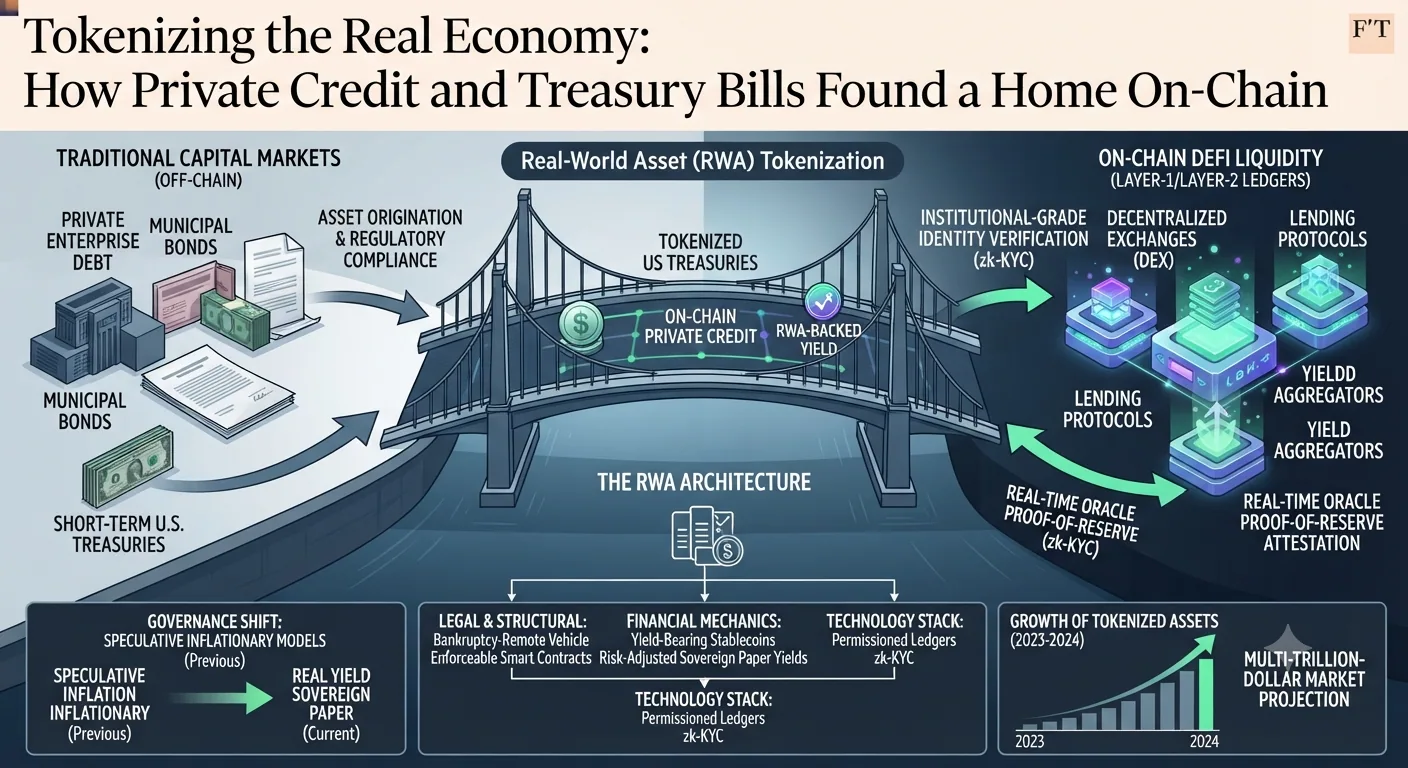
Tokenizing the Real Economy: How Private Credit and Treasury Bills Found a Home On-Chain

Wall Street's Ledger: How Institutional Custody and Sovereign Balance Sheets Redefined Crypto Volatility

Harvest of Glass: The Bitter Civil War Splitting Midwestern Farming Towns Over Solar Leases