Tokenizing the Real Economy: How Private Credit and Treasury Bills Found a Home On-Chain
⚠️ Truyện hư cấu phục vụ giải trí. Nhân vật & tình tiết là sản phẩm tưởng tượng.
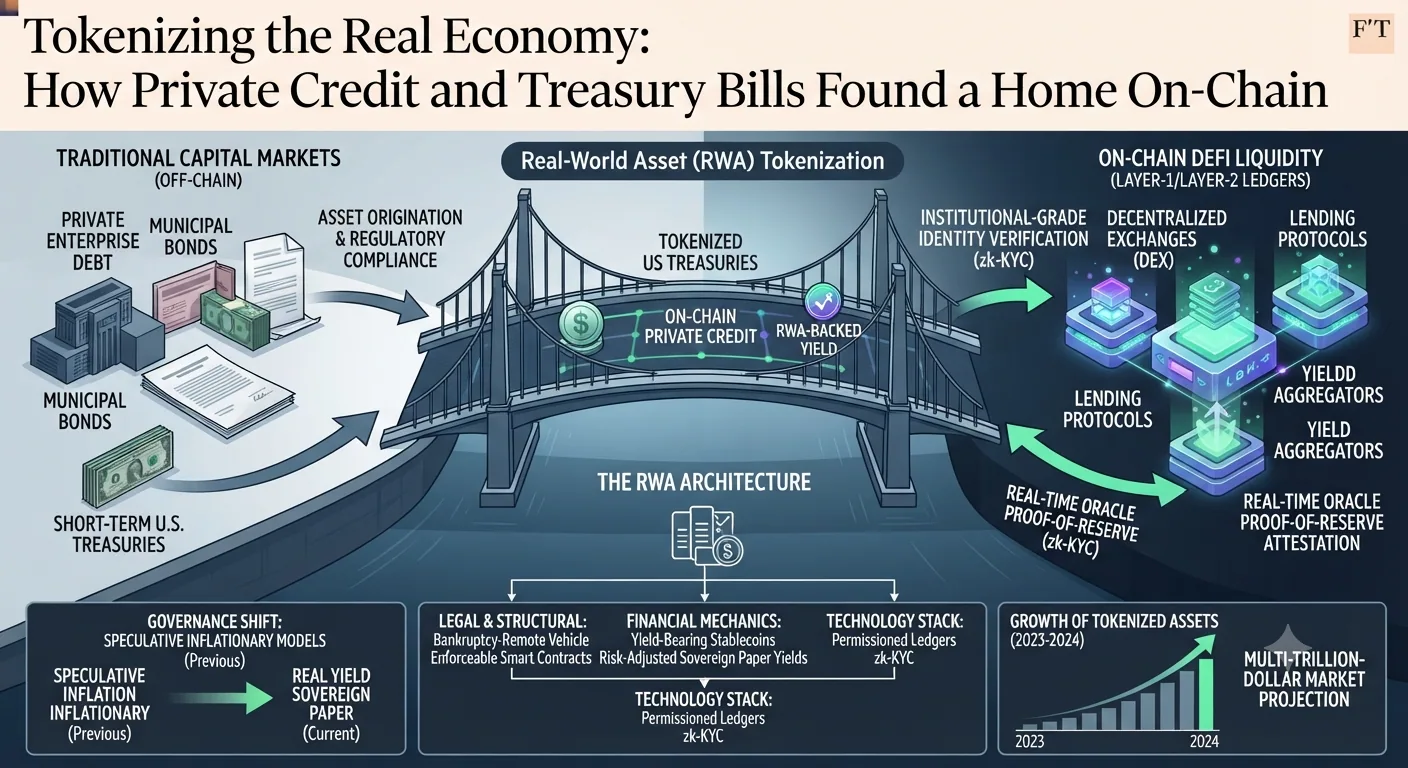
Real-world asset tokenization represents one of the most profound structural shifts in the architecture of modern global finance. For years, the digital asset ecosystem operated as a parallel financial universe, largely disconnected from the bedrock instruments that generate the vast majority of economic value in the traditional world. Decentralized finance grew at a breathtaking pace, creating sophisticated lending markets, automated market makers, and synthetic derivatives platforms. Yet, for all its technical ingenuity, the early iterations of decentralized finance suffered from a fundamental vulnerability: the underlying yield engines were almost entirely endogenous. Yield was generated by inflating native governance tokens, creating loops of speculative leverage that performed brilliantly during market bull runs but collapsed catastrophically when liquidity dried up. Participants in the decentralized economy looked across the chasm at traditional capital markets and recognized that a trillion-dollar bridge was desperately needed. That bridge is real-world asset tokenization, the process of bringing traditional financial instruments like short-term United States Treasury bills, commercial paper, municipal bonds, and private enterprise debt onto distributed ledgers.
To understand why this shift has captured the imagination of both Wall Street institutions and decentralized finance natives, one must examine the macro environment that gave rise to it. For over a decade following the global financial crisis, central banks maintained near-zero interest rate policies. Yield was scarce, and investors large and small were forced further out on the risk curve to achieve positive returns. In this environment, speculative crypto yields of twenty or thirty percent appeared irresistible. However, when inflationary pressures forced central banks to aggressively raise interest rates, the landscape changed overnight. Suddenly, risk-free sovereign paper was offering attractive, guaranteed yields of five percent or more. Decentralized treasuries, institutional crypto funds, and individual investors holding digital dollars realized they could no longer justify the smart contract risk and extreme volatility of purely endogenous crypto yields when they could get stable, sovereign-backed returns elsewhere. This realization sparked a massive migration of capital toward tokenized short-term U.S. Treasuries and money market funds. By wrapping traditional fixed-income securities into digital tokens, issuers created a seamless mechanism for decentralized market participants to access real-world yield without having to exit the blockchain ecosystem or navigate the friction-laden onboarding processes of traditional brokerages.
The mechanics of bringing traditional debt instruments on-chain are deceptively complex. A tokenized Treasury bill is not merely a digital receipt; it represents a legal claim on an underlying asset held in custody by a regulated financial institution. This requires a carefully constructed legal architecture, typically involving a bankruptcy-remote vehicle. A bankruptcy-remote vehicle is a special-purpose entity established in a reputable jurisdiction specifically designed to hold the underlying assets independently of the token issuer or any intermediary. If the issuing company were to face financial distress or insolvency, the underlying Treasuries or debt instruments remain protected, ensuring that token holders retain their rightful claim to the principal and accumulated interest. Furthermore, this structure must contend with cross-border jurisdictional realities. Capital flows frictionlessly across decentralized networks, but legal frameworks remain firmly anchored to nation-states. Managing jurisdictional compliance means that token issuers must integrate robust identity verification systems directly into the transactional layer of the ledger, ensuring that every wallet holding the asset has been properly vetted and complies with anti-money laundering and know-your-customer regulations across multiple global jurisdictions.
Institutional-grade security and compliance within tokenized capital markets rely heavily on advanced cryptographic primitives, most notably zero-knowledge proofs. In traditional finance, privacy and compliance exist in a perpetual state of tension. Regulators demand complete transparency to prevent illicit finance, while institutional investors and corporations demand confidentiality to protect proprietary trading strategies and sensitive financial data. Zero-knowledge identity verification solves this conundrum by allowing a user to prove they meet specific regulatory requirements, such as being an accredited investor or a non-sanctioned entity, without revealing any of their underlying personal data to the public ledger. Alongside identity verification, real-time oracle proof-of-reserve attestation systems serve as the vigilant watchdogs of the tokenized debt ecosystem. Because tokenized assets derive their value from off-chain collateral, there must be an unbroken chain of cryptographic and cryptographic-grade verification confirming that the digital tokens in circulation precisely match the traditional assets held in custody. Oracles pull verified data from custodian banks and auditors, publishing cryptographic proofs on-chain so that any participant can independently verify that every token is fully backed at all times.
The momentum behind real-world asset tokenization extends far beyond government securities into the vast and opaque world of private credit. Private credit has grown exponentially as traditional commercial banks retreated from lending to middle-market enterprises due to stringent regulatory capital requirements. Private credit funds stepped into this vacuum, providing bespoke loans to corporations, real estate developers, and specialized asset-backed lenders. Bringing private credit on-chain introduces unprecedented efficiencies to a market historically plagued by manual paperwork, slow settlement times, and extreme illiquidity. Through tokenization, private debt can be fractionalized, allowing a broader pool of capital to participate in loans that were previously accessible only to mega-institutions like pension funds and insurance companies. Moreover, smart contracts can automate coupon payments, principal repayments, and compliance checks, drastically reducing administrative overhead and operational costs for debt originators.
As private credit and tokenized debt scale within the decentralized ecosystem, a fierce competitive dynamic has emerged around yield-bearing stablecoins and tokenized money market funds. Traditionally, stablecoin issuers collected billions of dollars in reserve assets, predominantly short-term Treasuries, and kept the vast majority of the interest income for themselves while passing on zero yield to the end holders of the digital dollars. However, the introduction of native yield-bearing stablecoins has fundamentally altered this business model. Issuers are now competing fiercely for market share by passing a significant portion of the underlying Treasury yield directly back to token holders. This has created a race to the bottom on fees and a race to the top on yield sharing, forcing legacy stablecoin giants to rethink their value propositions. For decentralized finance protocols and treasury management DAOs, holding cash reserves that do not generate yield is increasingly viewed as an unacceptable opportunity cost. Consequently, integrating yield-bearing stablecoins and tokenized Treasuries has become standard operating procedure for any serious digital asset enterprise.
Yet, despite the undeniable promise and rapid growth of this sector, significant hurdles remain before real-world asset tokenization can achieve mass institutional adoption. Chief among these challenges is smart contract enforceability and the practical realities of debt default and collateral repossession. In a purely native decentralized finance loan, over-collateralization and algorithmic liquidation make default management relatively straightforward. If the collateral value drops below a certain threshold, smart contracts automatically liquidate the position on-chain. However, when dealing with real-world assets like commercial real estate loans, corporate debt, or municipal bonds, liquidation is a messy, physical process governed by local courts, bankruptcy judges, and physical asset sales. If a corporate borrower defaults on a tokenized private credit loan, smart contracts alone cannot seize a physical factory or enforce a legal judgment across international borders. Bridging this gap requires the creation of enforceable legal wrappers where smart contract states are legally recognized as binding instructions, or where trusted legal intermediaries act as execution agents bridging the digital and physical worlds.
The migration of Wall Street bond issuance and repurchase agreements toward permissioned and public distributed ledgers represents the bleeding edge of this financial evolution. Repo markets, which form the plumbing of global liquidity by allowing institutions to borrow cash overnight against high-quality collateral, are notoriously antiquated, relying on manual telephone calls, legacy messaging systems, and multi-day settlement cycles. By moving repo agreements onto programmable, distributed ledgers, financial institutions can execute atomic settlements where cash and collateral exchange hands simultaneously, eliminating counterparty risk and drastically reducing capital requirements. Major global investment banks, asset managers, and market infrastructures are actively experimenting with both permissioned enterprise networks and public layer-one blockchains to test these capabilities. They recognize that the technological superiority of tokenized rails—offering twenty-four-seven settlement, programmability, and composability—will eventually become the baseline standard for global capital markets.
The implications of this convergence between traditional debt and on-chain liquidity are profound. We are witnessing the construction of a unified financial system where the boundaries between traditional finance and decentralized finance begin to dissolve. In this future state, capital will no longer be trapped in siloed legacy systems or speculative crypto silos. Instead, it will flow seamlessly across global networks, guided by transparent code and backed by the most secure, yield-generating instruments in the global economy. As legal frameworks mature, cross-border jurisdictional hurdles are resolved, and institutional-grade oracle and identity systems become standardized, the multi-trillion-dollar debt markets of the world will find their permanent home on distributed ledgers. This transition does not merely modernize back-office infrastructure; it democratizes access to high-quality yield, enhances market transparency, and lays the enduring foundation for the next generation of global financial architecture.
Bài viết liên quan

Silicon on the Blockchain: How DePIN and Crypto Compute Markets Are Challenging Big Tech’s AI Monopoly
Wall Street's Ledger: How Institutional Custody and Sovereign Balance Sheets Redefined Crypto Volatility

Harvest of Glass: The Bitter Civil War Splitting Midwestern Farming Towns Over Solar Leases