Invisible Branches: How Fintech APIs and Neobanks Are Dismantling Traditional Banking
⚠️ Truyện hư cấu phục vụ giải trí. Nhân vật & tình tiết là sản phẩm tưởng tượng.
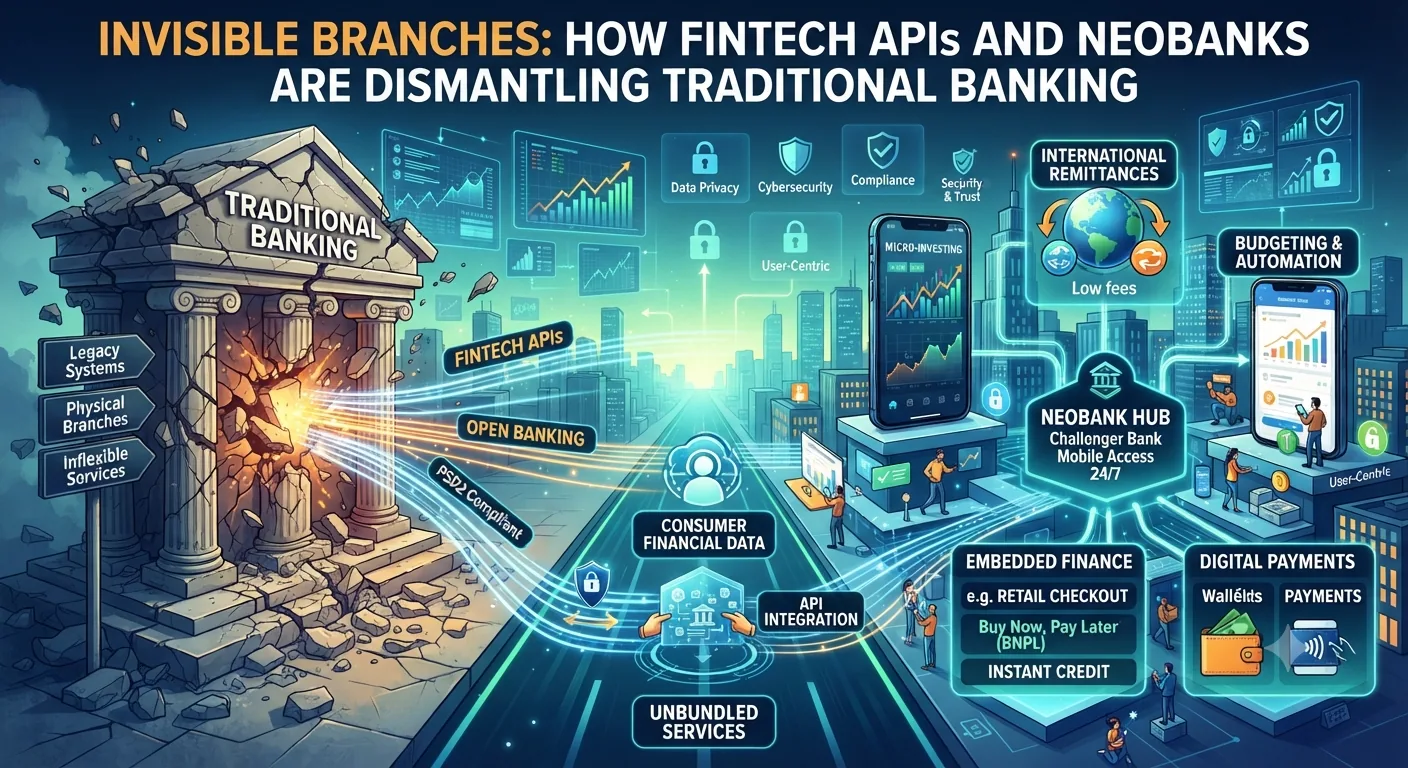
For generations, the cornerstone of personal and business finance was the local bank branch. When you needed a mortgage, a checking account, a small business loan, or a place to deposit your hard-earned savings, you walked through heavy glass doors into a marble-pillared lobby. You sat across a wooden desk from a loan officer who reviewed your paperwork, weighed your character, and decided whether you were worthy of financial services. That physical institution held a complete monopoly over your financial life. It was your vault, your advisor, your lender, and your payment processor all rolled into one monolithic entity. But over the past decade, that monolithic fortress has been systematically dismantled. We are living through a profound structural revolution in global finance, driven by software, connectivity, and changing consumer expectations. This revolution is known as the unbundling of financial services, fueled by open banking, application programming interfaces, and the meteoric rise of agile digital challengers called neobanks.
To understand how we reached this point, we have to look closely at how traditional banks operated for centuries. Legacy financial institutions were built as vertically integrated conglomerates. They built proprietary mainframes, internal databases, and closed-loop networks. If you wanted to check your balance, transfer money, invest in stocks, or apply for a loan, you had to do it within their ecosystem using their proprietary tools. These systems were famously siloed. Data did not flow easily between different institutions, and certainly not to third-party software developers. This created a high barrier to entry for new competitors and left consumers with very few choices. If you were unhappy with your bank's customer service or high fees, switching costs were notoriously high. You had to physically visit a branch, close your account, open a new one, and manually update all your automatic bill payments and direct deposits. It was an administrative headache that kept millions of customers loyal simply out of sheer friction and convenience fatigue.
Then came the digital revolution, which initially seemed like just an extension of the old model. When online banking first arrived in the late nineteen nineties and early two thousands, it was simply a digital replica of the physical branch. You could log on via a desktop computer to view your statement or pay a bill online, but the underlying architecture remained locked tight. The bank still controlled your data, and you still lived entirely within their walled garden.
The true turning point arrived when financial technology innovators began demanding access to the pipes and plumbing of the financial system. They realized that the real power of the internet was connectivity and interoperability. Why should a consumer's financial data be trapped inside a single bank database? Why couldn't a specialized budgeting app connect directly to your checking account to help you track your spending in real time? Why couldn't a streamlined digital lender pull your transaction history instantly to approve a loan in three minutes instead of three weeks?
This realization birthed the concept of open banking. At its core, open banking is a financial practice that gives users the right to share their financial data securely with third-party providers through technology called application programming interfaces, or APIs. Think of an API as a digital bridge or a standardized translator that allows different software systems to talk to each other securely. Instead of scraping data or forcing users to hand over their online banking usernames and passwords—a risky practice known as screen scraping—APIs provide a secure, tokenized, and permission-based pipeline for data exchange.
The regulatory push for this transparency started most notably in Europe with the implementation of the revised Payment Services Directive, commonly known as PSD2. Regulators recognized that bank data ultimately belonged to the consumer, not the institution holding it. By law, European regulators forced legacy banks to build open APIs that would allow authorized third parties to access customer account information and initiate payments, provided the customer gave explicit consent. This regulatory catalyst shattered the walled gardens. Suddenly, fintech startups didn't need to acquire a banking license or build a branch network to offer compelling financial services. They just needed an API connection to tap into existing customer accounts and layer superior user experiences on top of them.
This regulatory and technological shift triggered the great unbundling of financial services. For decades, traditional banks bundled everything together: you held your checking account, your savings, your credit card, your mortgage, and your investment portfolio all under one roof, cross-subsidizing products you rarely used with exorbitant fees on the ones you did. Open banking and modern APIs allowed nimble startups to unbundle these services one by one, picking apart the most profitable and customer-unfriendly aspects of traditional banking and reinventing them as standalone, best-in-class digital products.
Consider how personal investing was transformed. In the past, buying stocks meant calling a human broker or logging into a clunky legacy bank portal that charged hefty trading commissions per transaction. Then came micro-investing and commission-free trading platforms. These apps used API integrations to let users link their primary bank accounts, round up their daily digital coffee purchases to the nearest dollar, and automatically invest the spare change into fractional shares of global index funds or technology stocks. They turned saving and investing into a passive, gamified, and frictionless experience, appealing directly to a younger generation that found traditional brokerage firms intimidating and prohibitively expensive.
International remittances underwent a similar revolution. For generations, sending money across borders was an exercise in frustration. Traditional banks charged exorbitant foreign exchange markups, added hidden wire transfer fees, and took up to five business days for the funds to clear. Fintech challengers entered the market with streamlined digital platforms that used modern treasury networks and API connections to bypass traditional correspondent banking channels. They drastically lowered fees, offered real-time exchange rates, and completed international transfers in minutes instead of days. By focusing exclusively on remittances, they built a massive global user base that legacy banks simply could not compete with on price or speed.
Budgeting and personal finance management also broke free from the bank branch. Instead of trying to decipher complex, text-heavy monthly PDF statements, consumers began using sophisticated budgeting apps. These apps connect via open banking APIs to aggregate all of a user's accounts across multiple different banks, credit cards, and loan providers into a single dashboard. They automatically categorize spending, flag recurring subscription charges, predict cash flow shortages, and provide personalized financial coaching. The traditional bank is no longer the primary interface through which consumers view their financial lives; it has been relegated to a dumb pipe holding the underlying funds, while the sleek third-party app becomes the customer's primary financial command center.
As these specialized apps gained traction, a new breed of financial institution emerged to challenge the old guard head-on: the neobank, or challenger bank. Neobanks are fully digital financial institutions that have no physical bank branches. They operate entirely through mobile apps and websites, offering checking accounts, debit cards, savings accounts, and financial management tools. Because they do not have the massive overhead costs of maintaining physical real estate, paying armies of branch tellers, or maintaining legacy mainframe computer systems from the nineteen seventies, neobanks can pass those savings on to consumers in the form of zero account maintenance fees, no overdraft penalties, higher interest yields on savings, and immediate, in-app customer support.
Neobanks mastered customer acquisition through intuitive onboarding. Opening an account with a traditional bank often required booking an appointment, taking time off work, bringing physical proof of address and identification to a branch, and waiting days for a debit card to arrive in the mail. With a neobank, a user can download an app, snap a photo of their government-issued identification, complete a facial biometrics check, and have a fully functional digital bank account set up in less than five minutes. A virtual debit card is instantly added to their smartphone wallet, ready to be used for online shopping or tap-and-pay transactions immediately.
This frictionless experience resonated powerfully with digital natives, freelancers, gig workers, and urban professionals who valued speed, transparency, and design over marble pillars and paper statements. Neobanks quickly amassed tens of millions of customers globally, proving that the future of banking was mobile-first and cloud-native. However, operating purely as a fintech app has its limitations. Most early neobanks were not actually licensed banks themselves; instead, they partnered with legacy financial institutions that held the actual banking charters and deposit insurance. This partnership model allowed neobanks to move fast and innovate on the frontend, while leaning on traditional partners for regulatory compliance and balance sheet backing. Over time, many successful neobanks pursued their own banking licenses to gain full autonomy and expand their product suites into lending and mortgages.
While neobanks and specialized fintech apps were unbundling financial services from the outside, another powerful trend was quietly emerging from the inside out: embedded finance. Embedded finance is the seamless integration of financial services into non-financial digital platforms, websites, and apps. It means that banking, lending, insurance, and payments are no longer something you go to a bank to get; instead, they are woven directly into the everyday digital experiences you already use.
The most prominent and widespread example of embedded finance is Buy Now, Pay Later, commonly known as BNPL. When shopping on an e-commerce website for clothing, electronics, or travel, consumers are increasingly offered the option at checkout to split their purchase into four interest-free installments, paid over six weeks. This credit facility is not provided by the merchant, nor do you need to apply for a traditional credit card from a bank. Instead, a third-party BNPL fintech provider embeds its payment widget directly into the retailer's checkout flow. Using sophisticated machine learning algorithms and real-time alternative data points, the BNPL provider evaluates the consumer's creditworthiness in milliseconds and approves the transaction instantly.
This model transformed consumer spending and disrupted traditional credit card companies. It offered transparency—clear repayment schedules with no compounding interest—and captured a massive share of younger consumers who were wary of revolving credit card debt. Beyond BNPL, embedded finance now encompasses embedded insurance—where you can insure a smartphone at the exact moment you buy it online with a single click—and embedded business lending, where small merchants selling goods on e-commerce marketplaces can secure working capital loans directly through the merchant dashboard where they manage their inventory and sales.
For traditional banks, the rise of open banking, neobanks, and embedded finance presented an existential threat. They faced a stark choice: adapt or become obsolete. Initially, legacy financial institutions viewe
Bài viết liên quan

Behind the Rate Hikes: How Central Bank Decisions Impact Mortgages, Debt, and Daily Life
Stop Leaving Money on the Table: Why Traditional Savings Accounts Are Costing You Wealth

Harvest of Glass: The Bitter Civil War Splitting Midwestern Farming Towns Over Solar Leases