Beyond the Hype: Wall Street Demands Return on Investment from the Trillion-Dollar AI Capex Supercycle
⚠️ Truyện hư cấu phục vụ giải trí. Nhân vật & tình tiết là sản phẩm tưởng tượng.
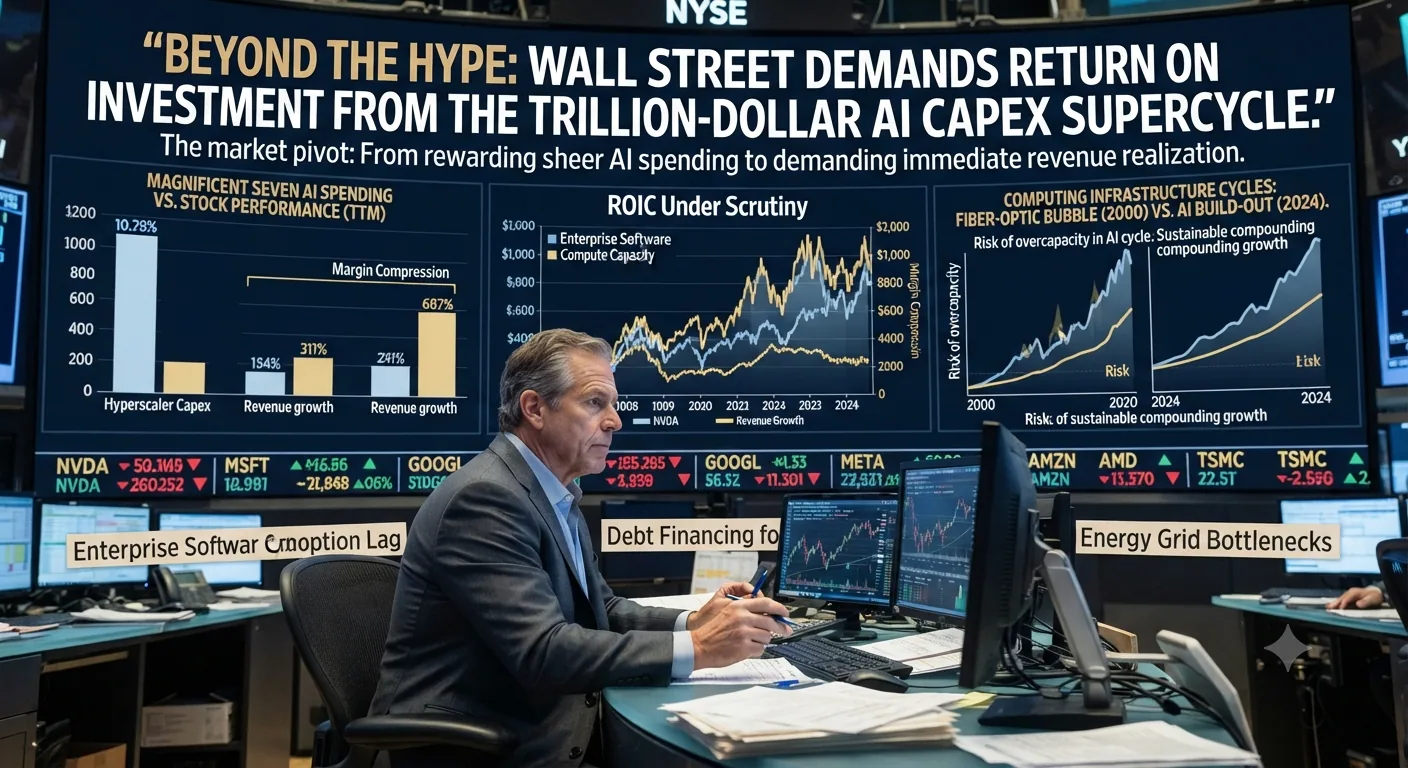
For years, the story of Wall Street was simple. If a technology giant announced billions upon billions of dollars in capital expenditures to buy advanced graphics processing units, build massive data centers, and secure nuclear power purchase agreements, equity research analysts cheered. The stock prices of the Magnificent Seven surged. Investors wanted to own the infrastructure providers, the chip designers, and the cloud computing titans who were staking their claims on the frontier of artificial intelligence. It was a gold rush mentality, where spending money was viewed as definitive proof of visionary ambition and guaranteed future dominance.
But the mood in financial circles has shifted. A new reality is setting in across trading desks from New York to London. Wall Street is no longer willing to write a blank check for indefinite infrastructure spending without seeing concrete, measurable returns. The honeymoon period of rewarding pure capital expenditure is drawing to a close. We have entered the era of the artificial intelligence capital expenditure reckoning, a tense and pivotal moment where massive corporate spending is directly colliding with sober investor expectations.
To understand why this friction matters so much right now, we have to examine the sheer scale of the investment cycle we are currently witnessing. The world's largest technology companies, often referred to as hyperscalers, have committed unprecedented sums of money to construct the physical backbone of the artificial intelligence revolution. These are not modest experimental budgets. We are talking about hundreds of billions of dollars deployed annually into specialized silicon chips, liquid cooling systems, vast expanses of server racks, and sprawling real estate developments designed to house compute clusters that consume as much electricity as small cities.
These companies have gone to extraordinary lengths to secure the power required to run these facilities. We have seen tech monopolies entering into direct commercial agreements with nuclear energy providers, resurrecting dormant reactors, and locking in long term power purchase agreements to ensure uninterrupted electricity supplies. From the outside, this looks like masterclass strategic foresight. After all, if intelligence is the new oil, then compute capacity is the refinery, and energy is the crude feedstock.
Yet, Wall Street is increasingly asking a very uncomfortable question. Where is the revenue? When you look at enterprise software adoption across the broader corporate landscape, the picture is considerably more nuanced and slower than the breakneck pace of infrastructure accumulation. While tech giants are buying hardware as fast as semiconductor manufacturers can churn it out, traditional enterprises are moving much more cautiously. Chief information officers across Fortune five hundred companies are grappling with complex integration challenges, data privacy concerns, regulatory compliance hurdles, and the difficult task of proving clear return on investment to their own boards of directors.
This temporal mismatch between lightning fast infrastructure buildout and deliberate, measured enterprise software adoption creates severe valuation pressure. The stock market is fundamentally a discounting mechanism for future free cash flows. When capital expenditures scale exponentially while software monetization scales linearly, return on invested capital inevitably compresses. Analysts are starting to model scenarios where the depreciation schedules of multi billion dollar data centers outpace the incremental revenue generated by generative artificial intelligence subscriptions and enterprise application add ons.
Margin compression is becoming the buzzword of the quarter. Investors are beginning to realize that maintaining sky high operating margins while simultaneously funding a generational infrastructure pivot is mathematically challenging. Even the most profitable monopolies on earth face gravity when their capital intensity spikes dramatically. When free cash flow yields shrink, the premium valuation multiples that these technology titans have enjoyed for years begin to look vulnerable to downward revaluation.
To fund this relentless infrastructure expansion, several of these technology monopolies have turned to the debt capital markets. Instead of relying solely on their prodigious internal cash flows, they have issued massive corporate bond tranches, testing the depth and appetite of global fixed income markets. While their pristine balance sheets mean they can borrow at highly favorable interest rates, the accumulation of debt to fund speculative technology cycles introduces a new risk factor that conservative equity investors cannot easily ignore. It changes the risk reward profile of owning these equities, shifting them subtly from pure cash rich growth engines toward capital intensive industrial style enterprises.
Whenever markets face such capital allocation dilemmas, financial historians and veteran portfolio managers look back for precedents. The obvious parallel that surfaces in every economic commentary is the telecommunications and fiber optic buildout of the late nineteen nineties. Back then, telecom giants laid millions of miles of glass fiber across continents and ocean floors, anticipating an exponential explosion in internet traffic. The infrastructure was real, and the long term vision was entirely correct. The internet did indeed consume that bandwidth and vastly more. But the timing was catastrophically miscalculated. Capacity outstripped demand by an astronomical margin, leading to a brutal industry bust, bankruptcies, asset write downs, and a lost decade for investors who bought at the peak of the infrastructure frenzy.
Are we hurtling toward a similar fiber optic style reckoning in artificial intelligence? The consensus among sophisticated market participants is nuanced. Unlike the dot com era, today's hyperscalers possess fortress balance sheets, massive ongoing revenue streams from established digital advertising, cloud computing, and e-commerce ecosystems, and genuine commercial demand that is already generating billions of dollars. This is not speculative capital funded by fly by night startups relying on junk bonds. This is cash rich corporate royalty placing massive strategic bets on their own future relevance.
However, the risk of localized overcapacity remains very real. If enterprise software adoption stalls, or if generative artificial intelligence tools prove to be more of a helpful productivity assistant rather than a revolutionary profit engine that justifies enterprise wide software price hikes, the market will harshly punish those who overbuilt. The penalty for misjudging the slope of the adoption curve is severe margin dilution and a painful compression of price to earnings multiples.
This dynamic has triggered a fascinating realignment in the broader economic ecosystem, particularly regarding who benefits most from the boom. While software developers and cloud providers bear the brunt of the margin pressure, unexpected secondary beneficiaries are emerging in the physical economy. Energy grid operators, electrical equipment manufacturers, high voltage transformer suppliers, and specialized commercial real estate developers find themselves in an enviable position of power. They hold the physical keys to the kingdom. Tech giants cannot simply wave a wand and summon megawatts of clean power or construct reinforced facilities with specialized cooling overnight. The physical bottlenecks of the modern world are exerting their revenge on the digital realm, transforming boring industrial utilities and equipment makers into high growth proxy plays on the artificial intelligence revolution.
For equity investors navigating this complex landscape, portfolio positioning has become an exercise in surgical precision. The simplistic strategy of buying the entire index or blindly accumulating the largest capitalization stocks is no longer sufficient. Investors are being forced to choose between different layers of the technology stack.
On one side, there is the picks and shovels strategy. This approach focuses on the semiconductor manufacturers, advanced lithography equipment makers, and specialized hardware designers who capture revenue upfront regardless of whether downstream software succeeds commercially. These companies sell the picks and shovels to the gold miners. They lock in their margins at the point of sale, making them less vulnerable to the long term monetization struggles of enterprise software. Yet, they remain cyclical businesses exposed to sudden inventory corrections and shifting hyperscaler capital expenditure budgets.
On the other side are the downstream operational software adopters and application layer innovators. These are the companies attempting to build proprietary workflows and industry specific solutions on top of the raw compute infrastructure. While their capital requirements are lower, their competitive moats are often harder to defend, and their path to proving durable pricing power is fraught with execution risk. Finding the winners in this segment requires deep fundamental research, industry expertise, and a sharp eye for actual customer retention rather than headline grabbing pilot projects.
Ultimately, the artificial intelligence capital expenditure reckoning represents a healthy and necessary maturation of a transformative technological cycle. Wall Street's initial euphoria has given way to rigorous financial scrutiny. The companies that will ultimately reward patient investors over the next decade will not necessarily be the ones that spent the most money the fastest. Instead, they will be the disciplined allocators of capital who successfully bridge the gap between raw infrastructure scale and genuine, cash generative economic utility. As the dust settles on this trillion dollar supercycle, the market is separating the visionary builders from the indiscriminate spenders, ensuring that the next chapter of the artificial intelligence boom is written in the ink of sustainable return on invested capital rather than the fading glow of speculative hype.
Bài viết liên quan
Weaponized Finance: Can the U.S. Dollar Maintain Hegemony Against a Fragmenting World?
The Yield Reality: How Stubborn Treasury Yields Are Forcing Wall Street to Rethink Risk

Harvest of Glass: The Bitter Civil War Splitting Midwestern Farming Towns Over Solar Leases