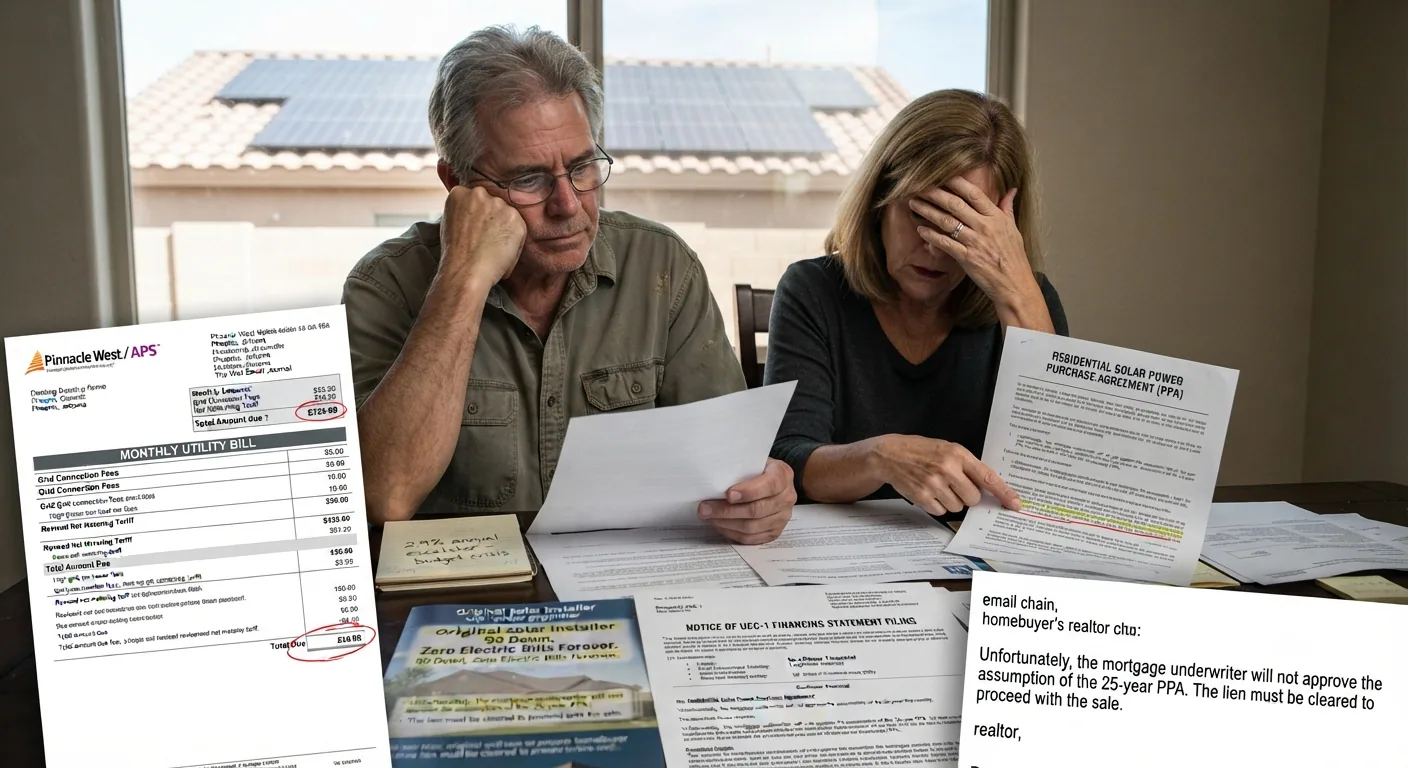
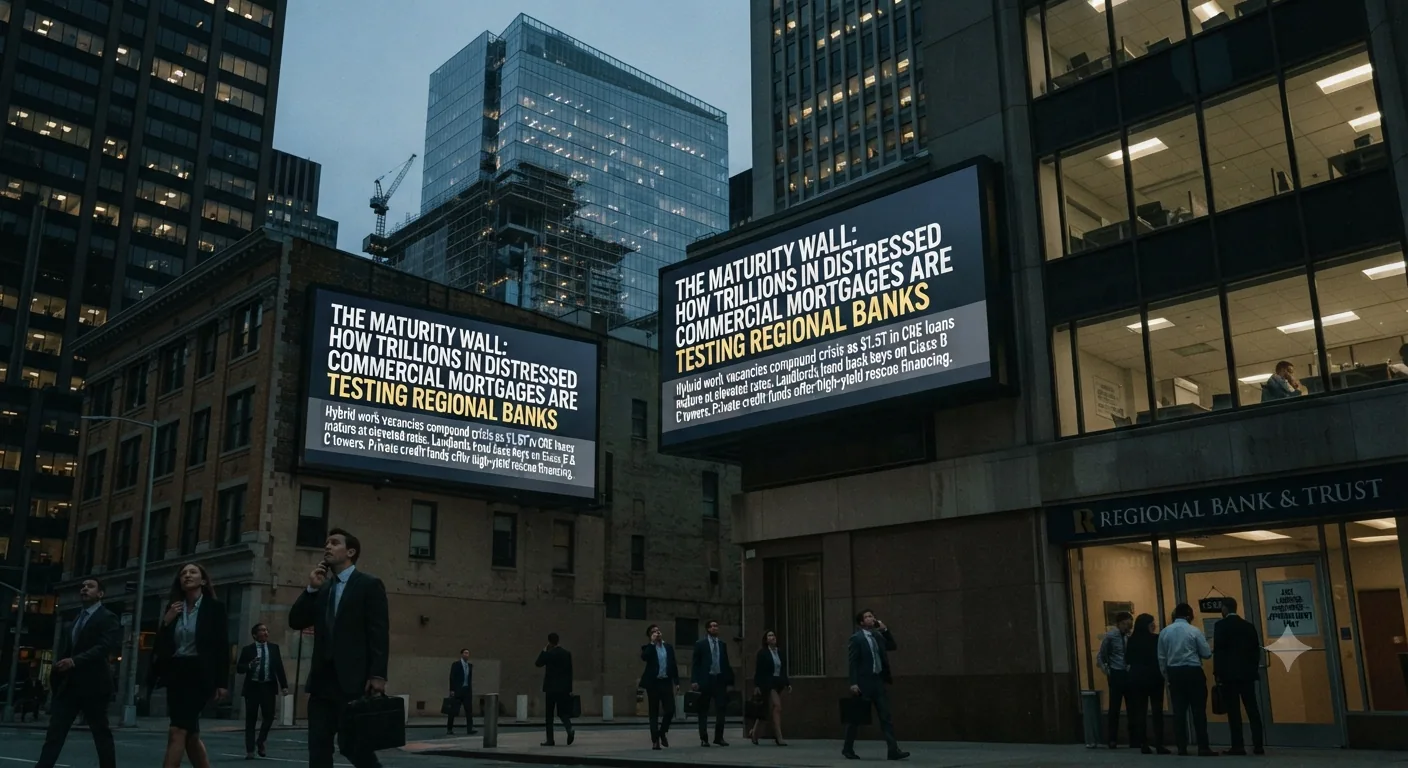
The Maturity Wall: How Trillions in Distressed Commercial Mortgages Are Testing Regional Banks
⚠️ Truyện hư cấu phục vụ giải trí. Nhân vật & tình tiết là sản phẩm tưởng tượng.
The commercial real estate market stands at a historic financial precipice, driven by the unprecedented convergence of structurally lower office demand, a massive wall of maturing debt, and a radically altered interest rate environment. For decades, commercial real estate functioned as a cornerstone of institutional and regional banking portfolios, offering predictable yields underpinned by long-term leases and tangible physical assets. Today, that foundational stability has fractured. Trillions of dollars in commercial mortgages originated during an era of ultra-low borrowing costs are coming due, forcing property owners, lenders, and investors to confront a harsh financial reality.
At the epicenter of this distress is the office sector, where the structural shift toward hybrid and remote work models has permanently altered space utilization. Across major metropolitan business districts, vacancy rates have climbed to historic highs, while utilization metrics reveal that physical office attendance remains a fraction of pre-pandemic averages. This decline in headcounts and footprint requirements is not merely a cyclical downturn; it represents a fundamental structural revaluation of workplace space. Corporations downsizing their square footage upon lease expiration have triggered a downward spiral in market rents, severely depressing net operating income across urban centers.
This fundamental erosion of operating income has collided directly with the commercial real estate refinancing wall. Loans secured during the past decade are now maturing at a time when benchmark interest rates are significantly higher. When a commercial mortgage reaches maturity, the borrower typically seeks to refinance the existing debt through a new loan or commercial mortgage-backed securities issuance. However, underwriting standards have tightened considerably, and lenders now demand lower leverage ratios and higher debt service coverage requirements to account for rising borrowing costs.
The mathematics of this refinancing squeeze are stark. Consider an office building whose net operating income has dropped by thirty percent due to rising vacancies and rent concessions. If that same property now faces a refinancing rate that is several hundred basis points higher than its original loan, the property's ability to service debt is severely compromised. Under current market valuations, many office properties are worth less than the outstanding principal balance of the debt encumbering them. In financial terms, these assets have become deeply underwater, trapping property owners in an untenable position where refinancing is mathematically impossible without massive injections of fresh capital.
Faced with the prospect of pouring millions of dollars of new equity into a distressed asset with an uncertain future, a growing number of commercial landlords are choosing strategic default. Rather than attempting to recapitalize underwater office towers, particularly Class B and Class C properties that lack modern amenities and energy-efficient building systems, owners are simply handing the keys back to their lenders. This practice of returning deeds in lieu of foreclosure marks a psychological and financial turning point, signaling that institutional sponsors are willing to walk away from billions of dollars in equity rather than throwing good money after bad.
The wave of defaults and distressed debt restructurings places immense pressure on the banking sector, particularly U.S. regional and mid-sized banks. While mega-cap money center institutions maintain highly diversified balance sheets and extensive capital buffers, regional lenders often carry high concentrations of commercial real estate debt relative to their total capital. For many community and regional banks, commercial mortgage lending was historically a core profit driver, providing stable, localized credit expansion. Today, that geographic and sector concentration has transformed into a systemic vulnerability.
As office loans mature and borrowers default, regional banks are forced to confront difficult choices regarding loan loss provisions, asset write-downs, and regulatory capital requirements. When a lender takes back an office building through foreclosure or a troubled debt restructuring, the property must be revalued at current market prices, which often reflects steep haircuts of forty to sixty percent compared to peak valuations. These dramatic write-downs eat directly into bank capital reserves. If loan losses escalate beyond expected thresholds, regional institutions face severe credit rating downgrades, increased funding costs, and heightened scrutiny from bank regulators monitoring systemic risk.
The systemic implications extend beyond individual regional banks to the broader commercial mortgage-backed securities market. Tranches of CMBS issued during the low-rate era are currently experiencing elevated default rates, rating downgrades, and special servicing transfers. Special servicers, tasked with managing distressed loans on behalf of bondholders, find themselves navigating complex inter-creditor disputes, protracted foreclosure proceedings, and the arduous task of stabilizing vacant buildings in weak leasing markets. The traditional playbook of working out troubled loans through maturity extensions and minor debt modifications often proves insufficient when the fundamental cash flows of the underlying real estate are permanently impaired.
In response to this capital vacuum, private credit funds and alternative asset managers have emerged as prominent players, stepping in to provide rescue financing, mezzanine debt, and high-yielding bridge loans. These private capital providers operate with greater flexibility than traditional regulated banks, allowing them to structure complex rescue packages that bridge the valuation gap between distressed borrowers and cautious lenders. However, this private credit intervention comes at a steep price. Rescue financing typically carries double-digit interest rates, heavy fee structures, and strict covenants that subordinate existing equity holders. While private credit provides vital liquidity to stave off immediate liquidations, it also imposes an onerous debt burden on properties that are already struggling to generate positive cash flow.
Amid this landscape of distress, industry participants and municipal leaders have increasingly looked toward adaptive reuse strategies, most notably office-to-residential conversions, as a potential lifeline for obsolete downtown towers. The prospect of transforming empty corporate cubicles into vibrant downtown housing units appears conceptually elegant on paper. It simultaneously addresses urban office glut and acute metropolitan housing shortages while revitalizing local economies through increased residential density. However, the architectural and economic realities of office-to-residential conversions present monumental hurdles.
The physical architecture of a typical mid-century or late-twentieth-century office building is fundamentally misaligned with residential floor-plan requirements. Office floor plates are typically expansive, designed with deep interior spaces far removed from exterior windows and natural light. Building codes strictly mandate that residential bedrooms must have egress windows and access to direct sunlight, making large, deep office floor plates extraordinarily difficult to subdivide efficiently. Architects must carve out expensive interior light wells or courtyards, a process that requires major structural alterations and significant capital expenditure.
Furthermore, the mechanical, electrical, and plumbing systems of commercial office towers present severe engineering challenges when retrofitted for residential use. Office buildings traditionally utilize centralized HVAC systems, shared multi-stall restroom facilities on each floor, and heavy-duty electrical risers that are ill-suited for individual apartment metering and control. Upgrading a building to support hundreds of individual kitchens, bathrooms, laundry connections, and customized climate control systems requires a complete gut-renovation of the core infrastructure. When combined with hazardous material abatement, such as the removal of extensive asbestos and lead paint common in older commercial structures, the cost per square foot for conversion can easily rival or exceed the cost of new ground-up construction.
Zoning and regulatory roadblocks add another layer of complexity to adaptive reuse initiatives. Many central business districts are governed by zoning ordinances strictly designated for commercial and industrial use, prohibiting residential occupancy. Navigating the labyrinth of municipal approvals, zoning variances, historical preservation mandates, and building code compliance can prolong project timelines by years. Recognizing these bottlenecks, several forward-thinking municipalities have introduced zoning reforms, tax abatements, and expedited approval processes to encourage conversions. Nevertheless, the underlying economic feasibility remains precarious. With high construction costs, elevated interest rates, and softening downtown residential rental markets in certain regions, private developers find that the math on office conversions only works with significant public subsidies or deeply discounted asset acquisition prices.
The ripple effects of commercial real estate distress extend far beyond landlords, lenders, and developers, touching municipal finances and local economic ecosystems. Urban centers rely heavily on property tax revenues generated by commercial office buildings to fund essential public services, including public education, transit infrastructure, emergency services, and sanitation. As office valuations decline and properties undergo reassessment, municipal tax bases face significant downward pressure. Cities that fail to diversify their tax revenues risk entering a fiscal feedback loop, where declining property tax collections lead to deferred maintenance, deteriorating public infrastructure, and a further erosion of urban competitiveness.
The broader macroeconomic environment continues to cast a long shadow over the sector's recovery timeline. While central banks have begun easing monetary policy from peak restrictive levels, the era of zero-interest-rate policy is firmly in the past. Borrowing costs are projected to remain structurally higher than the ultra-low levels that fueled the prior decade's real estate boom. This means that even as distressed assets are cleaned up, recapitalized, or sold at steep discounts to new buyers, the new capital stack must support higher debt service costs. Consequently, the days of easy speculative gains driven purely by cap-rate compression are over, replaced by an operational reality where real estate returns must be driven by active asset management, rigorous underwriting, and genuine cash flow generation.
As the maturity wall continues to roll forward, the commercial real estate market is undergoing a painful but necessary cleansing process. Weaker sponsors are being wiped out, over-leveraged portfolios are being restructured, and asset prices are resetting to reflect post-pandemic economic fundamentals. While regional banks face sustained earnings pressure and elevated provisioning requirements, the systemic threat of a generalized banking crisis stemming from commercial real estate remains contained through proactive regulatory oversight and targeted capital interventions. The transformation of urban business districts will take years, requiring patience, creative public-private partnerships, and innovative structural engineering. Ultimately, the commercial real estate market will emerge from this period of distress transformed, leaner, and better aligned with the structural demands of the modern economy, proving once again that capital markets possess a resilient capaci
Bài viết liên quan
The Uninsurable Sunbelt: How Insurance Costs Threaten Southern Real Estate
The Golden Handcuffs: Why America’s 3% Mortgages Have Frozen the Housing Market in Place
Harvest of Glass: The Bitter Civil War Splitting Midwestern Farming Towns Over Solar Leases