Leave No Trace: The Shift Toward Accountable and Regenerative Travel
⚠️ Truyện hư cấu phục vụ giải trí. Nhân vật & tình tiết là sản phẩm tưởng tượng.
For decades, modern travel has been championed as the ultimate pursuit of freedom, self-discovery, and global connection. We grow up looking at glossy travel magazines, vibrant social media feeds, and documentary series that invite us to pack our bags, catch a flight, and immerse ourselves in the boundless wonders of the world. Travel broadens the mind, breaks down cultural barriers, and injects much-needed capital into developing economies. Yet, as global mobility has surged to unprecedented levels, a darker, less-discussed reality has emerged in the shadows of the tourism industry. The sheer volume of human movement across the globe has begun to strain fragile ecosystems, overwhelm local municipal infrastructure, and commodify the rich, living heritage of indigenous communities. To understand the gravity of this crisis, we must look beyond the postcard-perfect imagery and confront the complex mechanics of contemporary tourism, recognizing that our wanderlust comes with a heavy ecological and social price tag.
The heart of the issue lies in the sheer scale of the phenomenon often referred to as overtourism. Famous historic landmarks, pristine beaches, and fragile mountain ecosystems are no longer just visited; they are routinely congested, trampled, and consumed by millions of travelers seeking the exact same bucket-list experience. When a quiet medieval town in Europe or a remote island in Southeast Asia sees its annual visitor count multiply tenfold in a matter of years, the local infrastructure cracks under the pressure. Water supplies run low, waste management systems collapse under mountains of single-use plastic, and housing markets spiral out of control as long-term residential homes are converted into short-term vacation rentals. This relentless influx transforms vibrant communities into hollowed-out theme parks designed solely for passing consumption. The economic benefits, while initially appealing, often prove fleeting or highly inequitable, flowing primarily to multinational hospitality conglomerates rather than the pockets of the local residents who bear the daily brunt of the disruption.
To unpack this dynamic, we must evaluate the delicate equilibrium between the economic benefits of tourism and the urgent necessity of environmental conservation. On one hand, tourism is a massive economic engine, supporting millions of livelihoods worldwide and providing vital foreign exchange earnings for countries rich in natural and cultural heritage. In many regions, conservation projects, national parks, and wildlife reserves are funded directly through entrance fees, permits, and visitor contributions. Without tourism, these protected areas might lack the financial resources to fight illegal poaching, deforestation, and habitat encroachment. However, when visitor numbers exceed the carrying capacity of an ecosystem, the environment begins to degrade rapidly. Coral reefs bleach and die from sunscreen chemicals and anchor damage, hiking trails erode into muddy scars, and native wildlife is driven away by the incessant noise and presence of human crowds. The challenge of modern environmental stewardship is therefore not to halt travel entirely, but to fundamentally recalibrate how we interact with the places we visit, shifting our mindset from passive consumption to active protection.
This realization has sparked a crucial evolution in travel philosophy, moving us far beyond the basic, often superficial eco-friendly habits of the past. For a long time, green tourism was defined by simple gestures: reusing hotel towels, turning off lights when leaving a room, or occasionally purchasing a carbon offset for a long-haul flight. While these practices are positive, they are no longer sufficient to address the compounding crises of climate change and biodiversity loss. Instead, contemporary travelers and industry leaders are embracing the concept of regenerative travel. Regenerative travel asks us to go a step further than sustainability. Sustainability focuses primarily on doing no harm, ensuring that we leave a destination intact for tomorrow. Regeneration, by contrast, challenges us to leave a destination demonstrably better than it was before we arrived. It involves actively contributing to the restoration of local ecosystems, supporting community-led conservation initiatives, and investing time, resources, and care into healing the socio-ecological fabric of the places we explore.
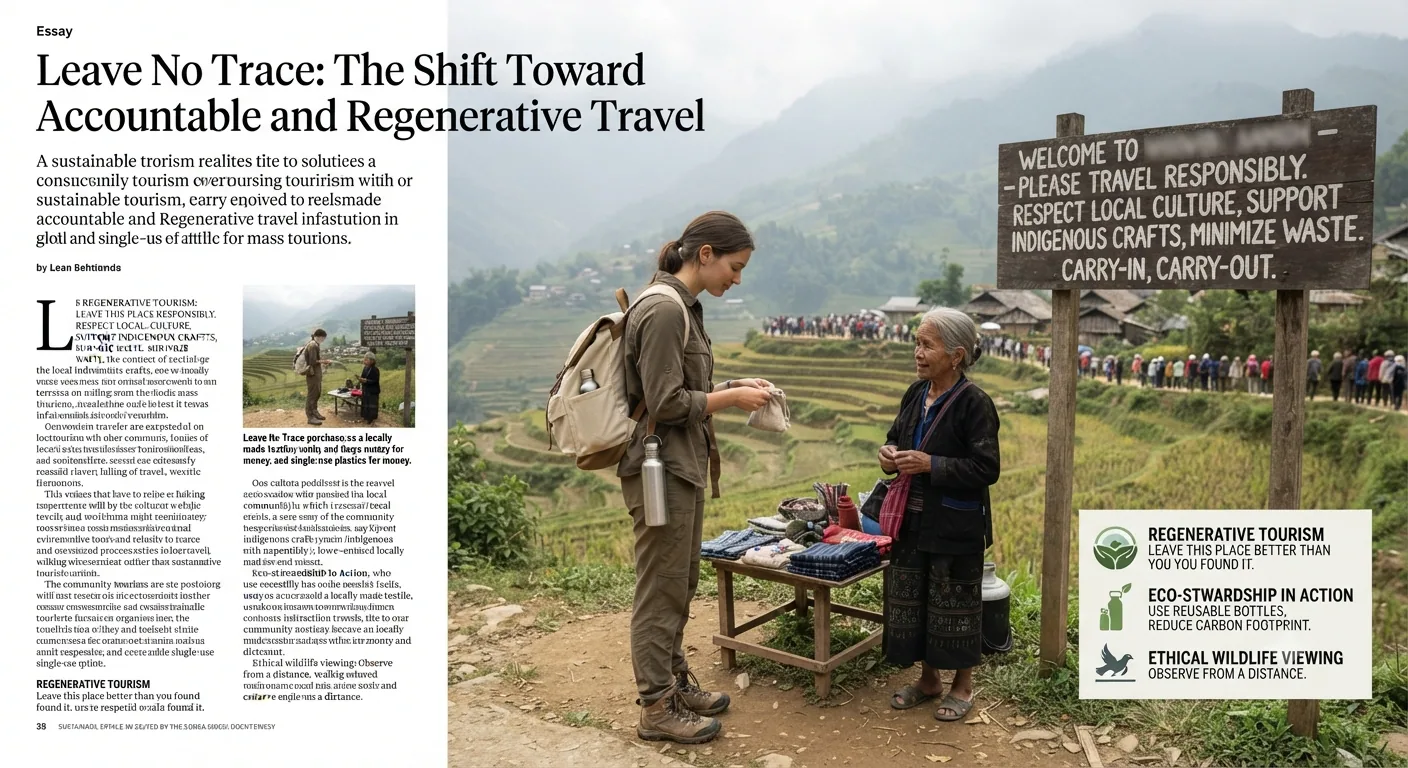
Transitioning to regenerative travel requires concrete, intentional actions in our daily planning and on-the-ground behavior. One of the most impactful shifts a traveler can make is supporting independent local vendors rather than large corporate chains. When we eat at family-owned restaurants, purchase crafts directly from local artisans, and book accommodations managed by residents, a significantly higher percentage of our travel expenditure stays within the local economy. This direct economic injection helps preserve traditional crafts, culinary arts, and cultural practices, empowering communities to maintain their identity rather than succumbing to homogenization. Furthermore, minimizing single-use plastics should become a non-negotiable personal standard. Carrying a reusable water bottle, cloth shopping bags, and personal utensils prevents tons of non-biodegradable waste from clogging local landfills and polluting oceans, especially in regions lacking advanced waste processing infrastructure.
Another critical frontier in conscious travel is the conscious selection of lower-emission transit options. Aviation is one of the fastest-growing contributors to global greenhouse gas emissions, and while eliminating flights entirely is impractical for international exploration, travelers can make smarter choices. Opting for direct flights when possible, packing lighter to reduce aircraft fuel consumption, and choosing trains, buses, or electric vehicles for regional travel dramatically lowers one's individual carbon footprint. Once at a destination, prioritizing walking, cycling, and public transit not only cuts down on urban air pollution and traffic congestion but also allows travelers to experience the rhythm of daily life far more intimately than they would from the window of a private tour bus or taxi.
Beyond environmental logistics, conscious travel also demands deep ethical reflection when interacting with wildlife and sacred cultural landmarks. Wildlife tourism, in particular, is fraught with ethical complexities. Many attractions that promise close encounters with wild animals—such as elephant riding, swimming with captive dolphins, or posing with sedated big cats—rely on severe animal cruelty and unethical breeding practices behind the scenes. True wildlife tourism respects the autonomy and natural behavior of animals, supporting sanctuaries, rescue centers, and natural habitat viewing where creatures are never exploited for human entertainment. Similarly, visiting sacred cultural landmarks, indigenous territories, and historical sites requires profound humility and respect. Travelers must remember that they are guests in living, breathing cultural spaces, not active participants in a personal photo shoot. Respecting local dress codes, seeking permission before photographing residents, and honoring sacred rituals and restricted areas ensures that cultural exchange remains a respectful dialogue rather than an intrusive spectacle.
As we navigate the complexities of our interconnected world, the way we travel serves as a powerful mirror of our values. The era of unbridled, consequence-free mass tourism is drawing to a close, replaced by an urgent need for accountability, mindfulness, and ecological stewardship. By embracing the principles of regenerative travel, respecting the carrying capacity of vulnerable destinations, and making deliberate choices that support local communities and protect natural habitats, we can redefine what it means to be a traveler. We can transform our journeys from acts of resource extraction into meaningful exchanges of respect, care, and renewal. Ultimately, the goal is not to stop exploring the magnificent diversity of our planet, but to ensure that our presence preserves its beauty, resilience, and vitality for the generations yet to come.