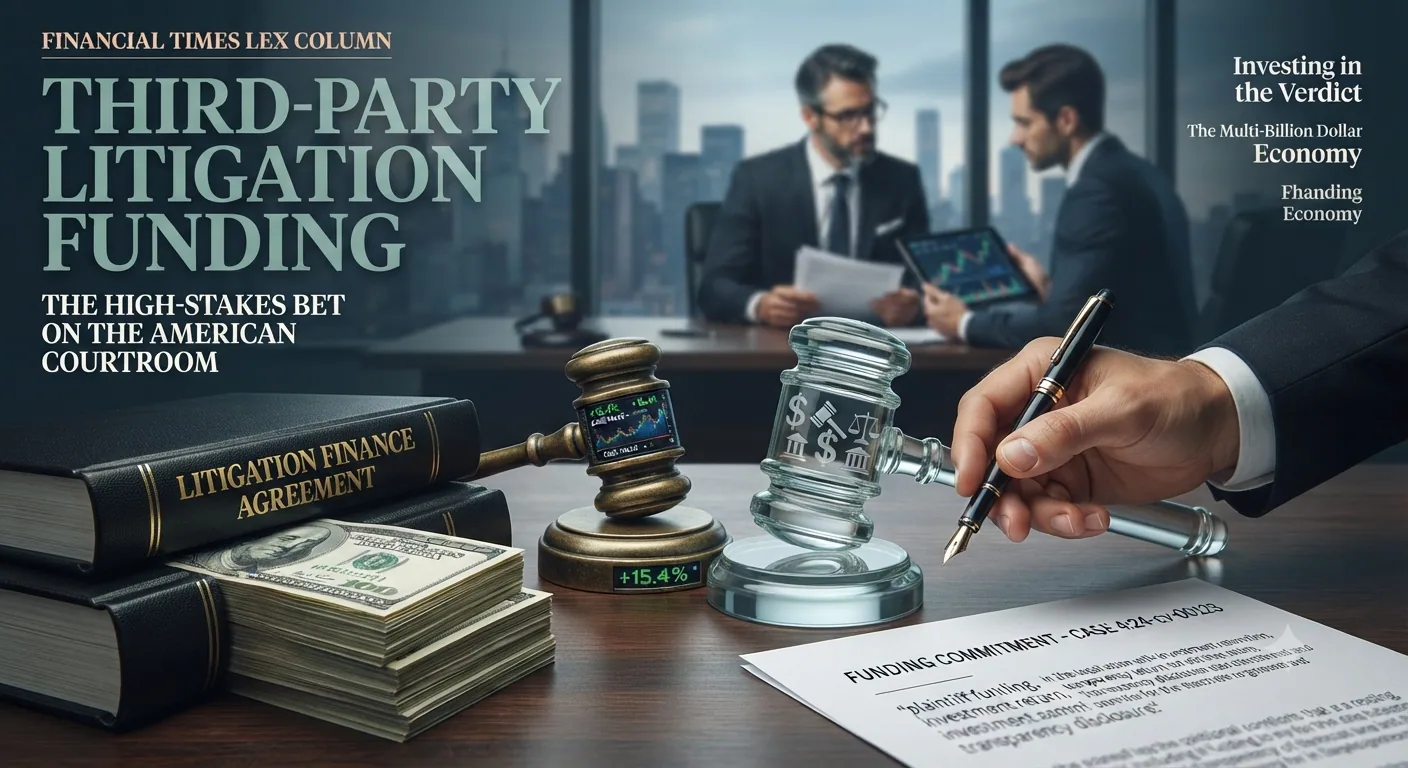
Investing in the Verdict: Inside the Multi-Billion Dollar Shadow Economy of Litigation Finance
⚠️ Truyện hư cấu phục vụ giải trí. Nhân vật & tình tiết là sản phẩm tưởng tượng.
Welcome to the hidden economic engine driving a massive transformation inside the American courtroom. If you have ever wondered how monumental multi-million or multi-billion dollar lawsuits actually get off the ground when the plaintiffs are cash-strapped individuals or mid-sized businesses battling deep-pocketed corporate behemoths, the answer increasingly leads to a multi-billion dollar shadow economy. It is a world known as third-party litigation funding, or TPLF for short. In this arena, Wall Street hedge funds, private equity giants, and even secretive sovereign wealth funds are treating the civil justice system like an alternative asset class. They are investing massive amounts of capital into lawsuits in exchange for a lucrative slice of the final judgment or settlement. This practice has fundamentally altered the dynamics of American jurisprudence, turning the courthouse into a high-stakes trading floor where verdicts are bundled, leveraged, and monetized.
To understand how we got here, we have to look at the traditional landscape of civil litigation. For generations, the primary mechanism that allowed everyday people or smaller enterprises to take on massive corporate wrongdoers was the contingency fee. In a standard contingency arrangement, a law firm takes on the financial risk of a lawsuit, advancing the costs of expert witnesses, depositions, and filing fees in exchange for a percentage of the ultimate recovery if they win. But as modern litigation grew infinitely more complex, expensive, and protracted—particularly in fields like mass torts, patent infringement, and antitrust class actions—even the largest plaintiff-side law firms began to feel the financial strain. Taking on a multinational conglomerate backed by endless legal defense budgets requires a war chest that can run into the tens of millions of dollars. Enter the specialized litigation funder.
These third-party investors step in to provide non-recourse financing. This means that if the plaintiff loses the lawsuit, the funder gets nothing. They absorb the total loss. But if the plaintiff wins or secures a settlement, the funder reaps an astronomical return on investment, often taking a significant percentage of the proceeds or a multiple of the original capital advanced. For cash-strapped plaintiffs, this kind of funding can be a lifeline. It levels the playing field against corporate giants who might otherwise try to outspend and out-delay justice until the plaintiff simply runs out of money and is forced to accept a pennies-on-the-dollar settlement. Proponents of TPLF argue that it promotes true access to justice, ensuring that meritorious claims can have their day in court regardless of the financial status of the injured party or the scale of the corporate defendant.
Yet, this influx of outside capital has ignited a fierce and deeply polarized debate across the legal and financial landscapes. Critics, particularly corporate defense counsels, chambers of commerce, and business advocacy groups, view third-party litigation funding with deep alarm. They argue that injecting Wall Street money into the court system fundamentally distorts the nature of justice. Instead of disputes being resolved on their legal merits, cases are increasingly managed, evaluated, and sometimes initiated through the cold, calculating lens of investment yield. Critics point to the risk of artificially inflated settlement demands, prolonged litigation cycles designed to squeeze defendants, and a growing cottage industry of speculative lawsuits that clog federal and state dockets.
One of the most profound legal concerns centers around ancient common law doctrines known as champerty and maintenance. Historically, these doctrines were designed to prevent outside interlopers from stirring up litigation for their own financial profit or meddling in legal disputes to which they were not originally a party. While modern legal evolution has relaxed many of these historical restrictions in various jurisdictions, the fundamental anxiety remains. When a third-party financier holds a multi-million-dollar stake in the outcome of a lawsuit, the question naturally arises: who is really driving the litigation strategy? Does the non-lawyer investor begin to dictate settlement terms? Does the deep-pocketed financier pressure plaintiffs to reject reasonable settlement offers in pursuit of a massive home-run verdict, even when the risk of total loss is high?
Furthermore, the involvement of third-party funders creates complex friction regarding attorney-client privilege and work product protection. In a traditional legal setting, the communications between a lawyer and their client are strictly confidential, designed to foster candid disclosures and robust legal representation. But when a litigation funder is underwriting the case, they require extensive due diligence, financial forecasting, and ongoing status reports to evaluate their investment risk. This operational necessity frequently blurs the boundaries of privilege. Defense attorneys routinely file motions to compel the discovery of funding agreements, arguing that they need to know if a hidden hand is pulling the strings behind the plaintiff's counsel, influencing case valuations, or dictating the pace of the litigation.
The controversy deepens when we look beyond domestic hedge funds and private equity firms. In recent years, a particularly sensitive trend has emerged: sovereign wealth funds and foreign capital quietly flowing into sensitive U.S. patent and trade secret disputes. When foreign entities—potentially backed by adversarial nations or strategic economic competitors—finance high-stakes intellectual property litigation against foundational American technology, defense, or pharmaceutical companies, national security and economic sovereignty enter the chat. These foreign investors can leverage the American court system to gain insights into proprietary technology, disrupt domestic market competitors, or extract lucrative settlements, all while operating from the shadows of opaque funding structures. This dimension has transformed TPLF from a niche commercial finance topic into a matter of pressing geopolitical and regulatory debate.
As the industry has scaled into a multi-billion-dollar global behemoth, the legislative and judicial pushback has grown increasingly aggressive. Across numerous state legislatures and federal courts, a powerful movement is underway demanding mandatory transparency and disclosure of third-party backers. Lawmakers are introducing bills that would require plaintiffs and their attorneys to formally disclose the existence of any third-party funding agreement at the outset of the litigation, revealing the identity of the funder and the terms of their financial stake. Proponents of these transparency measures argue that judges and defendants have a right to know who is really financing a lawsuit, especially when determining potential conflicts of interest, evaluating real parties in interest, or assessing who controls the settlement levers.
Predictably, the litigation funding industry and many plaintiff-side advocates fiercely resist these disclosure mandates. They argue that forced disclosure gives corporate defendants an unfair tactical advantage, allowing them to gauge the financial staying power of the plaintiff, exploit perceived weaknesses, and wage procedural warfare over the funding agreement rather than focusing on the core merits of the underlying dispute. They contend that commercial confidentiality should protect private investment contracts just as it does in other financial sectors. However, as more jurisdictions adopt mandatory disclosure rules and as appellate courts grapple with the unique evidentiary questions raised by TPLF, the veil of secrecy is slowly being pulled back.
Ultimately, third-party litigation funding represents a profound crossroads for the American civil justice system. It sits at the volatile intersection of high finance and constitutional jurisprudence. On one hand, it provides essential capital that can democratize the courtroom, allowing David to stand toe-to-toe with Goliath and hold powerful corporate wrongdoers accountable. On the other hand, it risks turning justice into a speculative commodity, introducing hidden conflicts of interest, inflating legal costs, and inviting foreign capital to weaponize American courts for private financial gain. As the legal community, state legislatures, and federal regulators continue to grapple with this shadow economy, one thing remains certain: the rules governing how lawsuits are financed will shape the future of American commerce and justice for generations to come.
Bài viết liên quan
Monopoly on Trial: How Antitrust Enforcement is Redefining Corporate Power

Killing the Clock: How Generative AI Is Forcing Wall Street Law Firms to Rethink the Billable Hour

Harvest of Glass: The Bitter Civil War Splitting Midwestern Farming Towns Over Solar Leases