Monopoly on Trial: How Antitrust Enforcement is Redefining Corporate Power
⚠️ Truyện hư cấu phục vụ giải trí. Nhân vật & tình tiết là sản phẩm tưởng tượng.
The modern landscape of American corporate law is undergoing its most radical transformation in nearly a century. Across federal courtrooms in Washington, California, and New York, the United States Department of Justice and the Federal Trade Commission have mounted an aggressive, coordinated offensive against the sprawling economic dominance of Big Tech. This regulatory renaissance has placed landmark legislation under the microscope, breathing new life into century-old statutes and forcing legal scholars, corporate executives, and federal judges to rethink what it means to possess and abuse monopoly power in the digital age. At the center of this titanic struggle is the Sherman Antitrust Act of eighteen ninety, a statute originally drafted to dismantle nineteenth-century railroad trusts and oil monopolies, now being forced to grapple with algorithms, cloud ecosystems, default search distribution agreements, and multi-sided digital platforms.
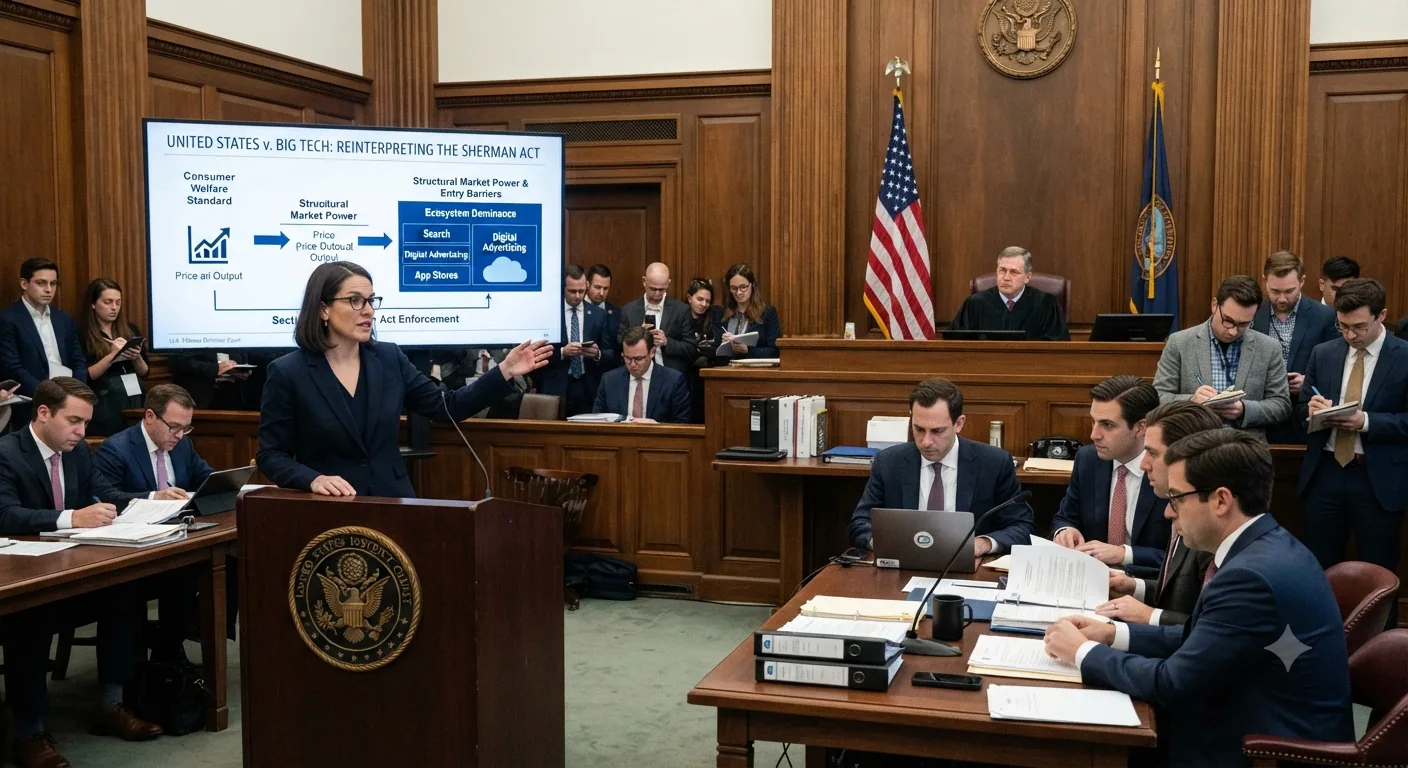
For decades following the Chicago School revolution in economic thought, American antitrust jurisprudence was anchored firmly to a single guiding star: the consumer welfare standard. Under this framework, antitrust enforcement was narrow, predictable, and largely permissive of corporate consolidation. Courts and regulators asked a singular, overarching question when evaluating a corporate merger or business practice: does this action result in higher retail prices or lower output for the end consumer? If a company could demonstrate that its products were inexpensive, or in the case of modern digital platforms, entirely free to the consumer, it stood on remarkably safe legal ground. The consumer welfare standard treated low prices and immediate consumer convenience as evidence of a healthy, efficient market, largely discounting the long-term structural health of competition, the suppression of nascent innovators, or the concentration of gatekeeper power over entire digital economies.
However, the digital economy exposed a profound blind spot in this traditional doctrine. How do you measure consumer harm when a search engine, a social media network, or an operating system costs the user zero dollars at the point of access? Big Tech firms mastered the art of offering deeply integrated, seemingly costless services to everyday users while quietly locking down the underlying infrastructure of the internet. Regulators realized that focusing solely on retail prices ignored a vast ecosystem of non-price harms. Today, the modern regulatory view championed by the Department of Justice and the Federal Trade Commission targets structural market power itself. Regulators argue that when a dominant platform controls the channels of distribution, sets the rules of engagement for entire industries, and erects insurmountable entry barriers, competition is stifled just as severely as if prices had been artificially inflated. The battle lines are thus drawn between defenders of the traditional consumer welfare standard and modern reformers who argue that economic liberty requires protecting the competitive process, not just short-term consumer prices.
This philosophical shift has erupted into high-stakes courtroom litigation across multiple fronts. Consider the landmark federal rulings addressing default search distribution deals and exclusionary bundling. In major antitrust challenges brought against search and digital advertising giants, federal prosecutors methodically dismantled the mechanics of how dominance is sustained and protected. By spending billions of dollars annually to secure default status as the exclusive search engine on web browsers, mobile operating systems, and consumer devices, these corporations effectively foreclosed the market to rival competitors. The legal argument hinged on the concept of market foreclosure, demonstrating that these multi-billion-dollar distribution payments were not merely aggressive marketing, but intentional, anticompetitive barriers designed to starve potential rivals of the scale necessary to compete. Federal judges scrutinized internal corporate documents, deposition testimony, and economic modeling to determine whether these exclusive defaults constituted illegal monopolization under Section 2 of the Sherman Act, setting precedents that will shape commercial behavior for generations.
The evidentiary burden in these cases has required federal regulators to pioneer sophisticated economic arguments. Proving harm in digital markets where services are free demands a pivot from traditional price analytics to metrics involving data privacy, advertising market concentration, innovation suppression, and consumer choice. Prosecutors and expert witnesses must demonstrate to federal judges how a lack of competition degrades quality, limits user choice in privacy settings, and imposes hidden taxes on advertisers who have nowhere else to turn. When a dominant platform acts simultaneously as a marketplace participant, a platform rule-maker, and an infrastructure owner, it possesses an inherent structural conflict of interest. Regulators have argued that this vertically integrated gatekeeper status allows tech giants to favor their own proprietary services, demote competitors in search rankings, and extract exorbitant fees from third-party developers who have no viable alternatives for reaching consumers.
Beyond courtroom litigation concerning historical conduct, the regulatory offensive has fundamentally altered the landscape of corporate mergers and acquisitions. For many years, large technology conglomerates grew not only through internal innovation but by acquiring nascent competitors before they could mature into genuine threats. This "buy-and-bury" strategy, or the acquisition of potential rivals to neutralize future competitive pressure, largely escaped rigorous antitrust scrutiny under the old consumer welfare regime. Today, however, corporate M&A deals face intense regulatory skepticism, protracted reviews, preliminary injunctions, and an unprecedented number of abandoned merger agreements. Both the Department of Justice and the Federal Trade Commission have updated their merger guidelines to reflect modern market realities, explicitly targeting transactions that tend to create a monopoly or substantially lessen competition, even in fast-moving technology sectors where future market boundaries are difficult to predict. When tech giants attempt to acquire promising artificial intelligence startups, cloud infrastructure providers, or social networking tools, they now anticipate aggressive federal intervention, multi-state coordination, and exhaustive court battles designed to block consolidation before it occurs.
As these federal cases wind their way through appellate courts and toward the Supreme Court, the ultimate question facing the American legal system revolves around remedy. When a court finds a corporation guilty of illegal monopolization under Section 2 of the Sherman Act, what is the appropriate corrective action? For decades, behavioral consent decrees—where companies agreed to modify specific business practices under judicial oversight—were the preferred remedy. However, many antitrust scholars and regulators now view behavioral remedies as largely ineffective bandages on structural fractures, noting that dominant firms routinely find ways to circumvent behavioral rules while maintaining their core market dominance. This has pushed structural remedies back into the spotlight. The discussion now includes the possibility of corporate breakups, forcing tech conglomerates to divest major business units, such as separating app stores from operating systems, or spinning off digital advertising exchanges into independent corporate entities. Such structural remedies are complex, risky, and bound to face fierce legal challenges, yet they represent the logical endpoint of a regulatory philosophy that views entrenched market power as incompatible with a dynamic, free-market economy.
The ongoing clash between federal antitrust enforcers and Big Tech is much more than a series of high-profile legal battles; it is a foundational redefinition of the social contract between corporate giants and the democratic state. By breathing new life into the Sherman Act and challenging the dogmas of the twentieth-century Chicago School, the Department of Justice and the Federal Trade Commission have established a new baseline for corporate accountability. As judges weigh evidence of market foreclosure, default distribution contracts, and non-price harms, the outcomes of these federal trials will determine whether the digital economy of the twenty-first century remains open to entrepreneurial innovation and fair competition or crystallizes into permanent, consolidated corporate empires. The legal architecture being forged today will echo across boardrooms and courtrooms for decades to come, proving that even the most powerful economic institutions remain ultimately subject to the rule of law.
Bài viết liên quan
Investing in the Verdict: Inside the Multi-Billion Dollar Shadow Economy of Litigation Finance

Killing the Clock: How Generative AI Is Forcing Wall Street Law Firms to Rethink the Billable Hour

Harvest of Glass: The Bitter Civil War Splitting Midwestern Farming Towns Over Solar Leases