Megawatt Bottleneck: The AI Boom Is Crashing Directly into America’s Aging Power Grid
⚠️ Truyện hư cấu phục vụ giải trí. Nhân vật & tình tiết là sản phẩm tưởng tượng.
For the last several years, the central narrative dominating the technology landscape has been a relentless, white-hot race for silicon. Every major headline, corporate earnings call, and geopolitical maneuver has revolved around the availability of specialized graphics processing units, advanced semiconductor packaging, and the sheer capital required to secure them. Wall Street analysts and venture capitalists tracked chip delivery schedules with the intensity of military intelligence officers, operating under the baseline assumption that whoever accumulated the most advanced hardware would inevitably win the artificial intelligence revolution. But as the industry pushes deeper into an era defined by massive frontier models and continuous real-time inference workloads, the foundational bottleneck of the entire digital economy has fundamentally shifted. The silicon exists, the venture capital flows in unprecedented volumes, and the algorithmic breakthroughs keep coming at a blistering pace. Yet a much more physical, intractable crisis has emerged to choke off this explosive momentum, and it has nothing to do with semiconductor fabrication plants or supply chain logistics in distant overseas manufacturing hubs. The ultimate bottleneck restricting the scale, deployment, and commercial viability of modern artificial intelligence is raw, unadulterated electricity, and the crumbling, archaic state of the electrical grid meant to deliver it.
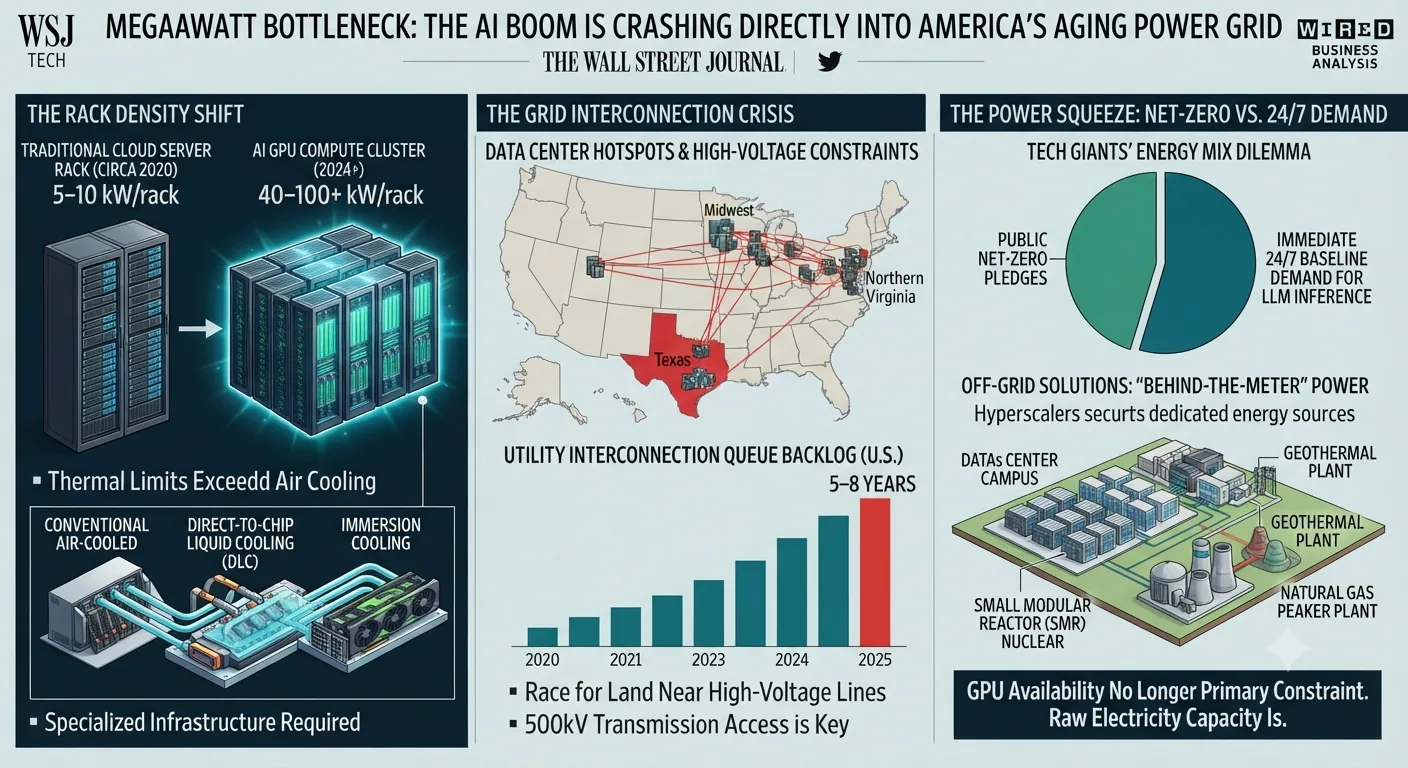
To understand how the technology sector arrived at this precarious precipice, one must examine the radical physical transformation occurring inside modern server facilities. For decades, the architecture of enterprise data centers was governed by a predictable, manageable set of engineering parameters. Traditional server racks, packed densely with standard enterprise hardware, typically pulled between five and fifteen kilowatts of power. Cooling these conventional units required little more than carefully engineered air circulation systems, large industrial fans, and standard computer room air conditioner units that managed ambient room temperatures without straining local municipal infrastructure. The power usage effectiveness metrics that operators used to gauge efficiency were steadily optimized, and utility providers could easily accommodate new facilities by factoring modest, incremental load increases into their long-term regional capacity planning. These historical assumptions have been entirely shattered by the sudden, brutal arrival of high-density graphic processing clusters designed specifically for large language model training and inference.
Modern high-performance compute clusters do not resemble their historical predecessors in scale, density, or operational behavior. A single contemporary AI-optimized server rack packed with advanced multi-chip accelerator modules now routinely draws anywhere from forty to over one hundred kilowatts, with next-generation architectures hurtling toward unprecedented thermal and electrical thresholds. When hyperscale operators deploy thousands of these high-density racks side by side within a single facility, the power density ceases to be a mere engineering detail and becomes an engineering nightmare. A single massive artificial intelligence data center campus can now demand hundreds of megawatts or even gigawatts of continuous, uninterrupted power, effectively matching the electricity consumption of a medium-sized American city. This astronomical surge has completely upended the operational reality of regional power grids across key geographic hotspots like Northern Virginia, Texas, and the industrial Midwest, where utility providers are suddenly confronting load growth numbers that completely defy their decade-old forecasting models.
The mismatch between how fast the tech industry can assemble compute clusters and how slowly the physical infrastructure of the electrical grid can adapt has created an unprecedented institutional gridlock. When a major cloud provider identifies a prime parcel of land with direct access to high-voltage transmission lines, they cannot simply plug their multi-gigawatt facility into the local wall socket. They must enter the formal electrical grid interconnection queues managed by regional transmission organizations. Historically, these queues were designed for a slow, orderly pipeline of traditional power plants and modest commercial developments. Today, those queues are severely clogged with massive data center applications stretching for miles, resulting in staggering interconnection backlogs that routinely stretch anywhere from five to eight years. An enterprise can spend billions of dollars purchasing land, securing advanced servers, and drafting architectural blueprints, only to discover that the local utility company cannot deliver the necessary electrons until well into the next decade. This multi-year delay has turned real estate strategy on its head, forcing technology giants to abandon traditional tech hubs and scramble for remote locations where local generation capacity or stranded energy assets can still be tapped before the queue completely locks them out.
Faced with this grinding institutional delay and the physical impossibility of waiting half a decade for grid upgrades, the world's largest cloud infrastructure providers have been forced to evolve from passive software and cloud giants into aggressive, vertically integrated energy companies. Microsoft, Amazon, and Google are no longer just buying server space; they are actively procuring, financing, and co-developing physical power generation facilities. To bypass the crippled public interconnection process, these corporations are pivoting heavily toward behind-the-meter energy solutions, establishing direct, exclusive relationships with carbon-free and fossil-fuel generators alike. The race to secure reliable baseline power has driven hyperscalers to invest heavily in restarted nuclear power plants, experimental geothermal ventures, and dedicated natural gas turbines that can sit adjacent to data center campuses and deliver uninterrupted power without ever touching the congested public transmission wires. This dramatic shift introduces complex economic and regulatory friction, particularly as state public utility commissions grapple with how the astronomical energy demands of private technology firms will impact local rate structures and residential electricity bills.
The tension between corporate sustainability mandates and the brutal, 24/7 realities of artificial intelligence workloads compounds this energy crisis even further. For years, major technology companies made ambitious public commitments to achieve net-zero carbon emissions, pledging to match their hourly electricity consumption with renewable energy credits and power purchase agreements tied to wind and solar farms. However, the operational nature of large language models completely breaks the intermittent profile of traditional renewables. Training a frontier model or servicing billions of daily inference queries requires a constant, unyielding baseline load that does not fluctuate based on whether the sun is shining or the wind is blowing. When a massive compute cluster fires up, it pulls a massive, steady load of electricity around the clock. Attempting to power these facilities exclusively with standard intermittent renewables without massive, grid-scale battery storage—which remains prohibitively expensive and scarce at this magnitude—has proven exceptionally difficult. Consequently, tech giants find themselves in a delicate corporate conflict, occasionally being forced to extend the operational lifespans of legacy fossil-fuel power plants or contract directly with natural gas providers to guarantee the firm, uninterrupted baseline power that artificial intelligence infrastructure demands to stay online.
Inside the data center walls, this intense electrical concentration triggers an equally severe thermal crisis that renders legacy environmental controls completely obsolete. Traditional air-cooling systems, which rely on moving large volumes of ambient air across server components, physically cannot dissipate the extreme heat generated by racks consuming upwards of one hundred kilowatts. When power density reaches these extreme levels, air simply lacks the specific heat capacity required to keep delicate silicon processors from thermal throttling or catastrophic failure. As a result, the industry is undergoing a mandatory, capital-intensive transition toward advanced liquid-cooling architectures. Operators are retrofitting or designing facilities from the ground up to utilize direct-to-chip liquid cooling, where engineered cooling fluids are pumped directly through micro-channels mounted on top of high-performance processors, or full immersion cooling, where entire server assemblies are submerged in specialized dielectric liquids. Implementing these closed-loop liquid systems requires a complete reimagining of data center plumbing, leak detection, pump redundancy, and facility maintenance, adding another massive layer of financial and operational complexity to an already strained infrastructure buildout.
As this multifaceted crisis deepens, the broader economic and market implications are becoming impossible to ignore. The traditional laws of supply and demand are undergoing a severe stress test as data center developers compete fiercely with heavy industry, manufacturing plants, and residential communities for a finite pool of available megawatt capacity. In certain regions, local opposition to proposed data center developments has intensified, with community leaders pushing back against the immense water consumption required for cooling towers and the looming threat of rising electricity rates. State legislators are increasingly stepping in to draft regulatory frameworks that require large computational facilities to bear the true cost of grid reinforcements, altering the fundamental financial models that made rapid data center expansion so attractive in the first place. Financial analysts who once modeled linear growth curves for the artificial intelligence sector are now furiously rewriting their projections to account for localized power shortages, regulatory delays, and the crippling cost of securing dedicated energy infrastructure.
Ultimately, the trajectory of the artificial intelligence revolution is no longer constrained by the ingenuity of software engineers, the brilliance of algorithmic researchers, or the manufacturing prowess of advanced semiconductor foundries. The hard ceiling on how fast artificial intelligence can scale, evolve, and permeate the global economy is dictated entirely by the physical capacity of our energy systems. The transition from a silicon-constrained market to an energy-constrained market marks a profound turning point in the modern technological landscape. Solving this immense challenge will require unprecedented cooperation between private enterprise, public utilities, and government regulators, alongside massive investments in next-generation generation technologies, grid modernization, and ultra-efficient hardware architectures. Until these foundational electrical and thermal bottlenecks are successfully resolved, the entire digital future remains anchored to the concrete reality of our aging power grid, waiting anxiously for the next megawatt to clear the queue.
Bài viết liên quan
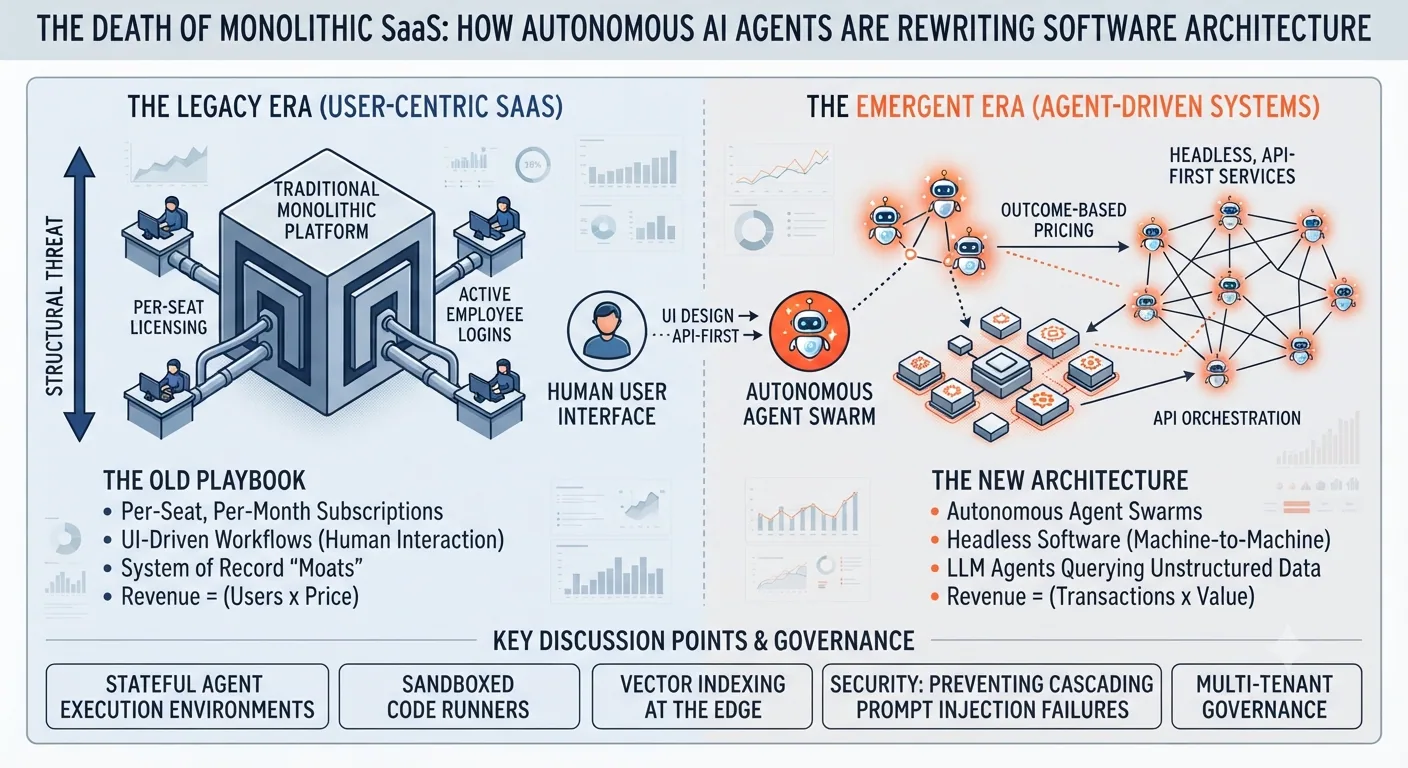
Unbundling the Seat License: How AI Agents Are Dismantling the Trillion-Dollar Enterprise SaaS Playbook
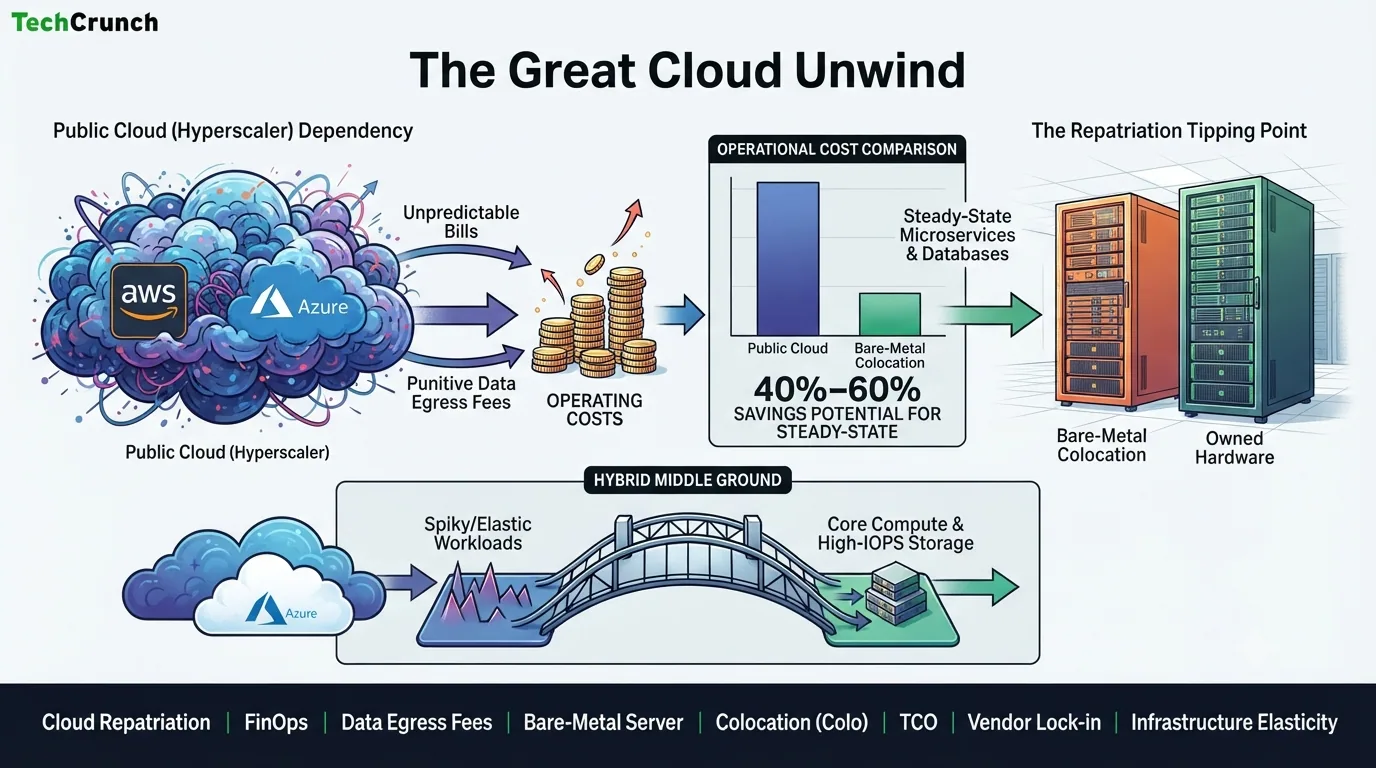
The Great Cloud Unwind: Why Predictable Workloads Are Fleeing AWS and Azure for Bare-Metal Colocation
Harvest of Glass: The Bitter Civil War Splitting Midwestern Farming Towns Over Solar Leases