Unbundling the Seat License: How AI Agents Are Dismantling the Trillion-Dollar Enterprise SaaS Playbook
⚠️ Truyện hư cấu phục vụ giải trí. Nhân vật & tình tiết là sản phẩm tưởng tượng.
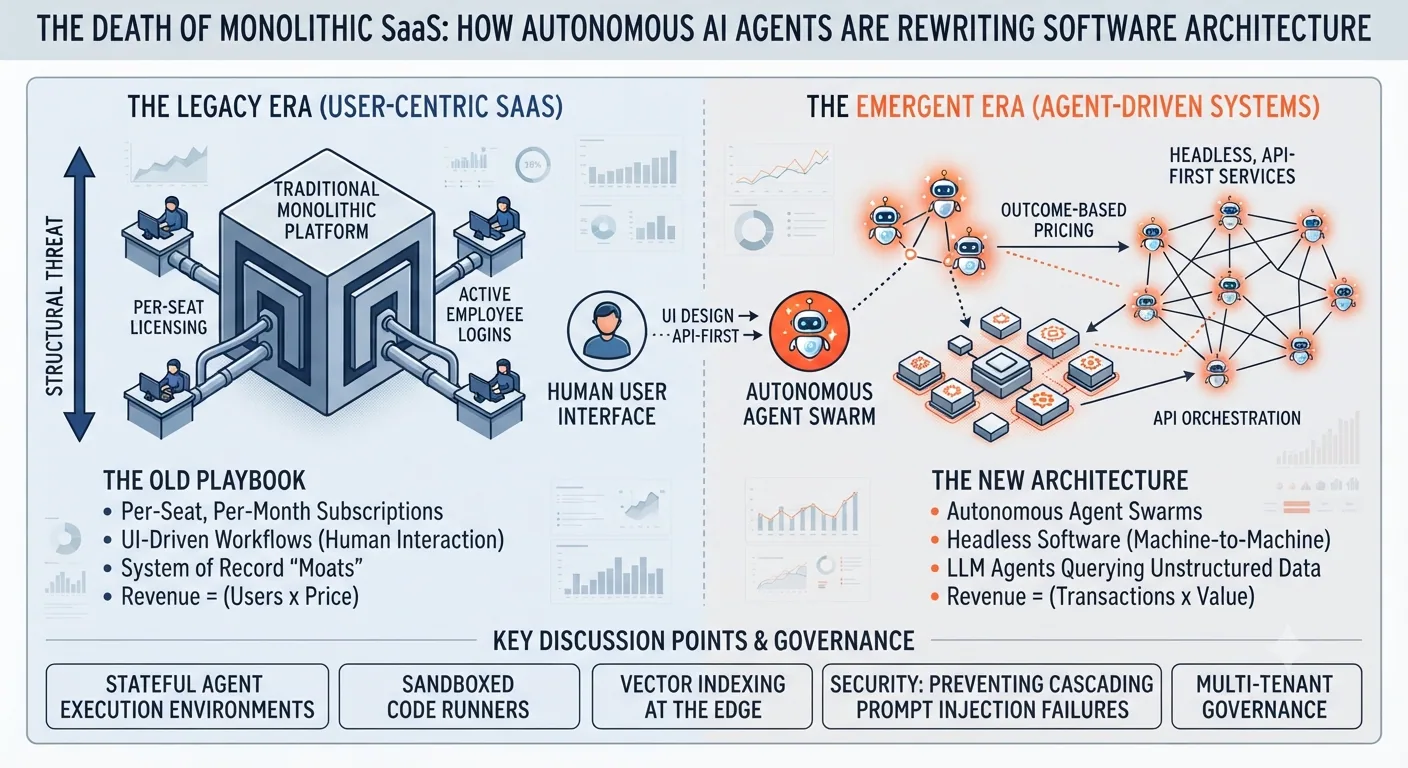
For decades, the enterprise software industry has operated on a remarkably simple and remarkably lucrative premise: the seat license. Whether you were looking at Customer Relationship Management systems, IT service management tools, project tracking platforms, or enterprise resource planning suites, the economic engine of software-as-a-service was tied directly to human headcount. You bought software by the user, per month, billed annually. More employees meant more licenses, which meant more recurring revenue for software vendors. It was a predictable, beautiful compounding machine that Wall Street rewarded with massive valuation multiples. Venture capitalists poured billions into companies whose primary defensibility relied on building sticky user interfaces that forced employees to spend eight hours a day clicking through forms, updating ticket statuses, and copying data from one siloed database into another.
That entire playbook is now facing an existential threat. We are witnessing the beginning of the end of monolithic enterprise software, and the catalyst is not a competing product with a slicker user interface or a cheaper subscription tier. The catalyst is the rise of autonomous AI agents. These systems do not care about user experience design, dark mode, keyboard shortcuts, or ergonomic button placement. They do not log in every morning at nine, take lunch at noon, and log off at five. They execute tasks asynchronously, process millions of tokens in seconds, invoke application programming interfaces directly, and reason across vast oceans of unstructured data without ever opening a graphical dashboard. As autonomous agents become the primary consumers of enterprise software, the traditional per-seat monetization model is breaking down, and the entire architecture of cloud applications is being rewritten from the ground up.
To understand why this shift is so disruptive, we have to look closely at what software moats have actually been made of over the past fifteen years. For a long time, the ultimate defensibility for an enterprise vendor was being the system of record. If all of your customer support tickets lived in one platform, or all of your sales pipelines lived in another, migrating away from that system was practically impossible because of the immense friction of data migration, retraining staff, and remapping business logic. The user interface was the gatekeeper. Because humans needed a structured way to interact with complex databases, vendors built elaborate web applications with forms, dropdown menus, and validation rules. The stickiness of the software was directly proportional to how difficult it was for a human user to learn a new interface.
Autonomous AI agents completely bypass this moat. An agent does not need to be trained on a proprietary dashboard because it does not use the graphical interface at all. Instead, it interacts with the underlying system through programmatic interfaces, using application programming interfaces, structured JSON payloads, and direct database queries. When an AI agent can read an unstructured email, extract the relevant customer intent, cross-reference it with historical purchase data in a data warehouse, execute a refund through an API call, and update three different downstream ledgers in a fraction of a second, the human-facing user interface becomes an irrelevant middleman. The system of record is no longer defined by who owns the pretty web application where humans type data; it is defined by who owns the core data infrastructure and the API gateway that the agents query.
This transition marks a fundamental shift from user-centric software to headless, API-first architecture. In a headless paradigm, the frontend user interface is decoupled from the backend logic and database. Traditionally, headless architecture was adopted to allow companies to serve content across multiple devices, like mobile apps, smartwatches, and kiosks. But in the age of agentic workflows, the primary consumer of the headless backend is not another client application—it is an autonomous software agent or a swarm of cooperating agents. Software vendors are realizing that their web applications are essentially legacy wrappers built for human limitations, while the real value lies in the raw computational engine and the programmatic surface area exposed to machine intelligence.
As a result, developer platforms are evolving rapidly to support stateful agent execution environments. Building software for human users meant optimizing for latency thresholds of a few hundred milliseconds, rendering smooth animations, and managing state across browser sessions. Building software for autonomous agents requires an entirely different set of infrastructure primitives. We are seeing the rise of specialized runtime environments designed specifically to host long-running, multi-step agent workflows. These environments require robust sandboxed code runners where agents can safely write, test, and execute scripts on the fly to solve novel problems. They require advanced vector indexing and retrieval-augmented generation pipelines embedded directly at the edge, allowing agents to search through petabytes of enterprise data with semantic precision rather than rigid SQL queries. Furthermore, these platforms must maintain state over hours, days, or even weeks of complex task execution, handling interruptions, retries, and asynchronous feedback loops without losing the thread of the overarching business objective.
This structural transformation naturally creates a massive pricing crisis for the enterprise software industry. If software vendors continue to rely on seat-based pricing while their human customers deploy thousands of autonomous agents that reduce the required human headcount, those vendors are effectively destroying their own revenue base. If a company uses AI agents to automate seventy percent of its customer support workflow, its need for human support agent licenses plummets. Under a traditional per-seat model, the software vendor would see its revenue collapse even as the enterprise customer derives vastly more value and output from the system. This economic contradiction is driving the inevitable emergence of outcome-based pricing.
Outcome-based monetization changes the fundamental nature of the vendor-customer relationship. Instead of charging for access or usage, vendors will charge for verified results. In this new economic model, an enterprise does not pay twenty dollars a month for a license; it pays a fraction of a cent per successfully resolved customer ticket, per fully compliant loan application processed, or per verified supply chain optimization executed. This aligns the software vendor's revenue directly with the business value generated by the AI agent. However, transitioning to outcome-based pricing is exceptionally difficult. It requires sophisticated telemetry, verifiable audit trails, and agreed-upon definitions of what constitutes a successful outcome. It also shifts risk onto the software provider, who must ensure their agent swarms perform reliably and accurately, because errors or hallucinations directly impact profitability.
Of course, opening up enterprise systems to autonomous agents introduces unprecedented security and operational governance challenges. When software was used exclusively by humans, security models relied on perimeter defenses, role-based access control, and the inherent friction of human behavior to prevent catastrophic errors. A human employee might try to download unauthorized customer lists, but it takes time, leaves traces, and is bounded by human cognitive speed. Autonomous agents operate at machine speed, and when they are granted API access to core enterprise systems, the attack surface expands exponentially.
One of the most insidious threats in this new architectural era is the cascading prompt injection attack. Unlike traditional software vulnerabilities like SQL injection or buffer overflows, prompt injection exploits the fundamental way large language models process instructions. If an autonomous agent processing incoming customer emails encounters a malicious payload hidden inside a seemingly normal support ticket—a payload designed to trick the model into overriding its safety guidelines—the agent might interpret that text as a legitimate command. It could then use its authorized API credentials to exfiltrate sensitive database records, alter financial transactions, or delete critical records across connected SaaS platforms. Because modern enterprise software relies on deeply interconnected multi-tenant cloud environments, a single compromised agent in one workflow can potentially cascade through connected APIs, poisoning data and executing unauthorized actions across an entire corporate ecosystem.
Securing multi-tenant architectures in the age of autonomous agents requires a complete reimagining of identity and access management. Traditional user authentication tokens, which assume a human is sitting behind the session, are inadequate. We need cryptographically verifiable agent identities, fine-grained capability tokens that restrict what specific actions an agent can take, and real-time behavioral monitoring systems that can detect when an agent is veering off its authorized execution path. Furthermore, enterprises need robust human-in-the-loop checkpoint mechanisms for high-stakes transactions, ensuring that while routine operations are fully automated, major financial or legal commitments still require explicit human authorization and verification.
As monolithic SaaS gives way to decentralized, agent-driven architectures, the entire landscape of enterprise technology is being redrawn. Companies that built their fortunes on proprietary user interfaces and rigid seat licenses must pivot quickly to become API-first platforms that empower agent swarms, or risk becoming legacy utilities. The winners of the next decade will not be the vendors who build the best dashboards for humans to look at; they will be the platforms that provide the most reliable, secure, and intelligent infrastructure for autonomous agents to execute the work of the modern enterprise.
Bài viết liên quan
Megawatt Bottleneck: The AI Boom Is Crashing Directly into America’s Aging Power Grid
The Great Cloud Unwind: Why Predictable Workloads Are Fleeing AWS and Azure for Bare-Metal Colocation

Harvest of Glass: The Bitter Civil War Splitting Midwestern Farming Towns Over Solar Leases