The Great Cloud Unwind: Why Predictable Workloads Are Fleeing AWS and Azure for Bare-Metal Colocation
⚠️ Truyện hư cấu phục vụ giải trí. Nhân vật & tình tiết là sản phẩm tưởng tượng.
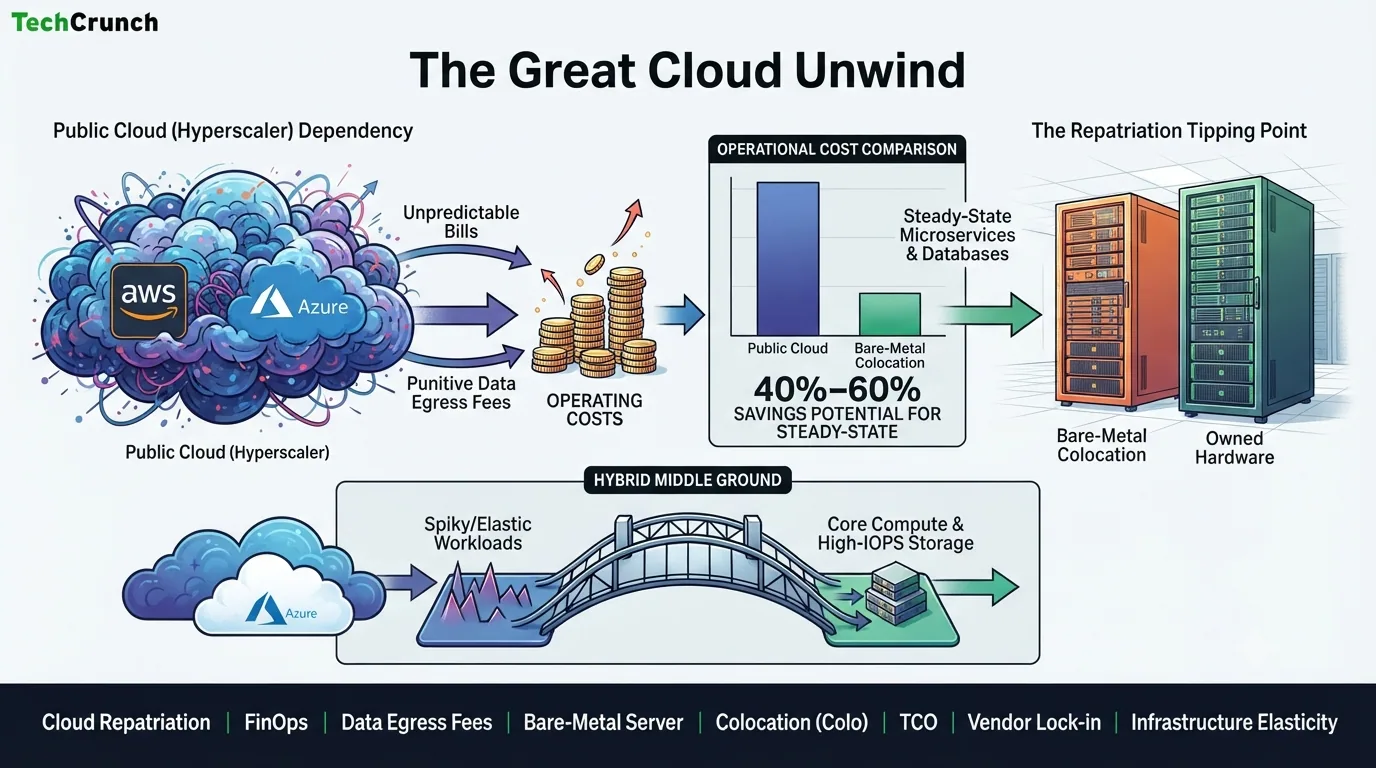
For over a decade the tech industry lived under a single dominant orthodoxy. Every venture backed startup, every growing scale up, and every legacy enterprise was told that the ultimate destination for digital infrastructure was the public cloud. The promise was seductive. You could spin up thousands of servers with the click of a button, scale dynamically to meet unpredictable traffic spikes, and forget about the operational headache of physical hardware. Data centers filled with humming server racks, blinking lights, and tangled Ethernet cables were cast aside as relics of a bygone era. The future belonged to the hyperscalers. Amazon Web Services, Microsoft Azure, and Google Cloud Platform became the default foundation of the modern internet. For a long time, the math seemed to work, or at least the convenience masked the creeping financial reality. But as companies matured from scrappy startups into high volume scale ups, a quiet reckoning began to brew in boardrooms and engineering departments alike. The monthly cloud bill stopped looking like a flexible utility expense and started looking like an existential tax on growth. Today, a profound and growing countertrend is sweeping through the enterprise technology landscape. It is known as cloud repatriation, and it represents a fundamental rethinking of where and how modern software should run. Companies that once migrated everything to the cloud are now packing up their databases, container clusters, and microservices, moving them out of hyperscale data centers, and bringing them back to bare metal servers and colocation facilities. This is not a nostalgic retreat into the past, but a hardnosed economic and architectural correction. To understand why this movement is gaining momentum, we need to look past the marketing gloss of infinite elasticity and examine the harsh financial and operational realities that companies face once they reach scale.
The primary catalyst for the cloud repatriation movement is the relentless compounding of infrastructure costs. When a company is small, the public cloud is undeniably efficient. You pay only for what you use, avoiding the upfront capital expenditure of buying expensive physical hardware before you have revenue to justify it. You do not need a team of specialized data center technicians or network engineers because the hyperscaler handles the underlying infrastructure plumbing. But as a business grows, the economics undergo a radical inversion. Predictable, steady state workloads that run twenty four hours a day, seven days a week, three hundred sixty five days a year become extraordinarily expensive to host in a multi tenant public cloud. In a cloud environment, you pay a steep markup for convenience, virtualization overhead, and managed services. When your user base stabilizes and your traffic patterns become consistent, you no longer need the dynamic elasticity that the cloud was designed to provide. You are essentially paying retail luxury prices for a commodity resource that you consume in industrial quantities month after month.
Compounding this baseline cost inflation are the notorious hidden charges that hyperscalers use to lock customers into their ecosystems. Chief among these are data egress fees. Moving data into the public cloud is almost always free, because hyperscalers want to make it as frictionless as possible for you to commit your data to their storage buckets and databases. But pulling that data back out to the open internet, or transferring it to a competing cloud provider, incurs punishing financial penalties. For a modern scale up dealing with terabytes or petabytes of user generated content, analytics data, or media streaming, these egress fees act as a digital moat, trapping your data inside a walled garden. If you want to run analytics on your cloud stored data using an external tool, or if you simply want to migrate to a more cost effective provider, you are hit with a massive financial toll. This creates a severe form of vendor lock in. Companies find themselves trapped not necessarily because the technology is superior, but because the cost of exit is prohibitively high.
Beyond compute and storage margins and egress penalties, there is also the myth of universal cloud elasticity. The entire justification for the cloud premium is the ability to scale seamlessly up and down. Yet many mature software architectures do not actually take advantage of this elasticity in a meaningful way. If your core database needs to run at near maximum capacity around the clock to handle baseline user demand, you are not flexing up and down; you are just renting a massive, oversized instance permanently. When you factor in the cost of managed database services, automated backups, cross region replication, and premium input output operations per second tiers, the monthly bill can easily rival or exceed the cost of leasing top tier physical hardware outright. The total cost of ownership over a three to five year lifecycle reveals a staggering discrepancy. Running steady state workloads on bare metal servers housed in colocation facilities can routinely cut operating costs by forty to sixty percent compared to running the identical workload on AWS or Azure. For a growing scale up burning through venture capital or trying to protect operating margins in a tightening macroeconomic climate, reclaiming half a million or a million dollars a year in infrastructure waste is not just an optimization; it is a matter of corporate survival.
The most visible pioneer of this countermovement has been the software company thirty seven signals, the makers of basecamp and hey. Their decision to leave the public cloud and migrate their entire infrastructure back to owned and leased hardware sparked a massive industry wide conversation. Their engineering leadership published detailed financial breakdowns showing how millions of dollars were being squandered on cloud rentals for predictable, heavy workloads. They demonstrated that by purchasing high performance servers, installing them in secure colocation data centers, and running modern container orchestration platforms, they could achieve predictable performance at a fraction of the cost. Other large scale SaaS providers, media streaming platforms, and data intensive enterprises quietly followed suit. They realized that treating infrastructure as a pure utility makes sense for unpredictable experiments and spiky traffic, but treating core, mature applications as permanent cloud tenants is an unnecessary drag on profitability.
However, moving away from the hyperscalers is not a simple matter of unplugging from the cloud and plugging into a rack. It involves a fundamental trade off in operational responsibility. When you use public cloud managed services, you are essentially outsourcing your operational overhead. If a managed database fails, or if a storage cluster requires a security patch, the cloud provider handles the underlying remediation behind the scenes. You pay for that peace of mind through higher invoices. When you repatriate your workloads to bare metal or colocation facilities, you lose that safety net. You are suddenly responsible for the physical hardware lifecycle, network switching, hardware failures, firmware updates, and capacity planning. If a motherboard fries at three o'clock in the morning, your own internal engineering team or your colocation provider's remote hands service has to physically replace it.
This operational shift has given rise to a new appreciation for platform engineering and in house infrastructure teams. To succeed in cloud repatriation, a company needs skilled engineers who understand Linux systems administration, advanced networking, storage architectures, and container orchestration platforms like Kubernetes. For a long time, the software industry suffered from a skills gap, where a generation of developers grew up knowing only how to interact with cloud APIs via configuration files, treating servers as magical, abstract entities. Bringing workloads back to bare metal requires a return to foundational systems engineering. Companies must invest in robust internal tooling, automated provisioning, and rigorous monitoring to match the reliability and observability they previously took for granted in the public cloud. For many scale ups, this transition requires building out a dedicated infrastructure or site reliability engineering team. Yet, even when factoring in the salaries of these specialized engineers, the net financial savings of leaving the hyperscalers are often so profound that the math still overwhelmingly favors repatriation.
Adding momentum to this shift is the explosive rise of alternative infrastructure providers, often referred to as neoclouds or developer centric hosting platforms. Companies like Hetzner, Equinix Metal, OVHcloud, and DigitalOcean are filling the vast chasm between expensive hyperscale cloud providers and the old school complexity of traditional enterprise data centers. These providers offer the best of both worlds. They provide modern, API driven access to bare metal servers and virtual private servers with predictable, transparent pricing and zero data egress fees. You can spin up dedicated physical servers with massive core counts, abundant RAM, and high performance NVMe storage in minutes, all without signing multi million dollar enterprise contracts or navigating labyrinthine discount tiers. This democratization of bare metal infrastructure has lowered the barrier to entry for cloud repatriation. A scale up no longer needs to buy and maintain its own physical server cages in every region it operates in; it can lease dedicated hardware from a trusted colocation or neocloud partner and manage its software stack with the exact same level of automation it used in the public cloud.
As the industry matures, the prevailing architectural consensus is moving away from dogmatic extremes. The future is not about abandoning the cloud entirely, nor is it about keeping everything locked in a single hyperscale ecosystem. Instead, the modern enterprise infrastructure strategy is defined by a pragmatic hybrid model. Companies are learning to be highly intentional about where different workloads live based on their specific economic and technical profiles. Spiky, unpredictable, and ephemeral workloads are kept in the public cloud. If you are launching a new product feature with unknown user adoption, or if you run batch processing jobs that spike for two hours a day, the infinite elasticity and rapid provisioning of AWS or Azure remain unmatched. You let the hyperscaler absorb the overhead of scaling for those variable demands. But for core compute engines, primary databases, high throughput microservices, and massive data storage repositories that operate at a steady hum around the clock, companies are bringing them home. They are repatriating these workloads to bare metal and colocation facilities to strip out unnecessary markup, eliminate predatory egress fees, and regain control over their own technology stack.
This evolution marks a maturing of the tech sector as a whole. The era of reckless, unquestioning cloud consumption is coming to an end, replaced by an era of disciplined financial governance, often tracked under the banner of FinOps. Engineering and finance teams are sitting down together to scrutinize unit economics, tracing every dollar of cloud spend back to the specific customer value it generates. As scale ups face increasing pressure to demonstrate sustainable growth and healthy profit margins, the massive leakage of capital into unnecessary cloud overhead is no longer tolerated. The Great Cloud Unwind is proof that convenience has its limits. When the price of renting digital real estate outweighs the cost of owning and managing it yourself, the market inevitably corrects. By embracing bare metal colocation, leveraging alternative neoclouds, and a
Bài viết liên quan
Megawatt Bottleneck: The AI Boom Is Crashing Directly into America’s Aging Power Grid
Unbundling the Seat License: How AI Agents Are Dismantling the Trillion-Dollar Enterprise SaaS Playbook
Harvest of Glass: The Bitter Civil War Splitting Midwestern Farming Towns Over Solar Leases